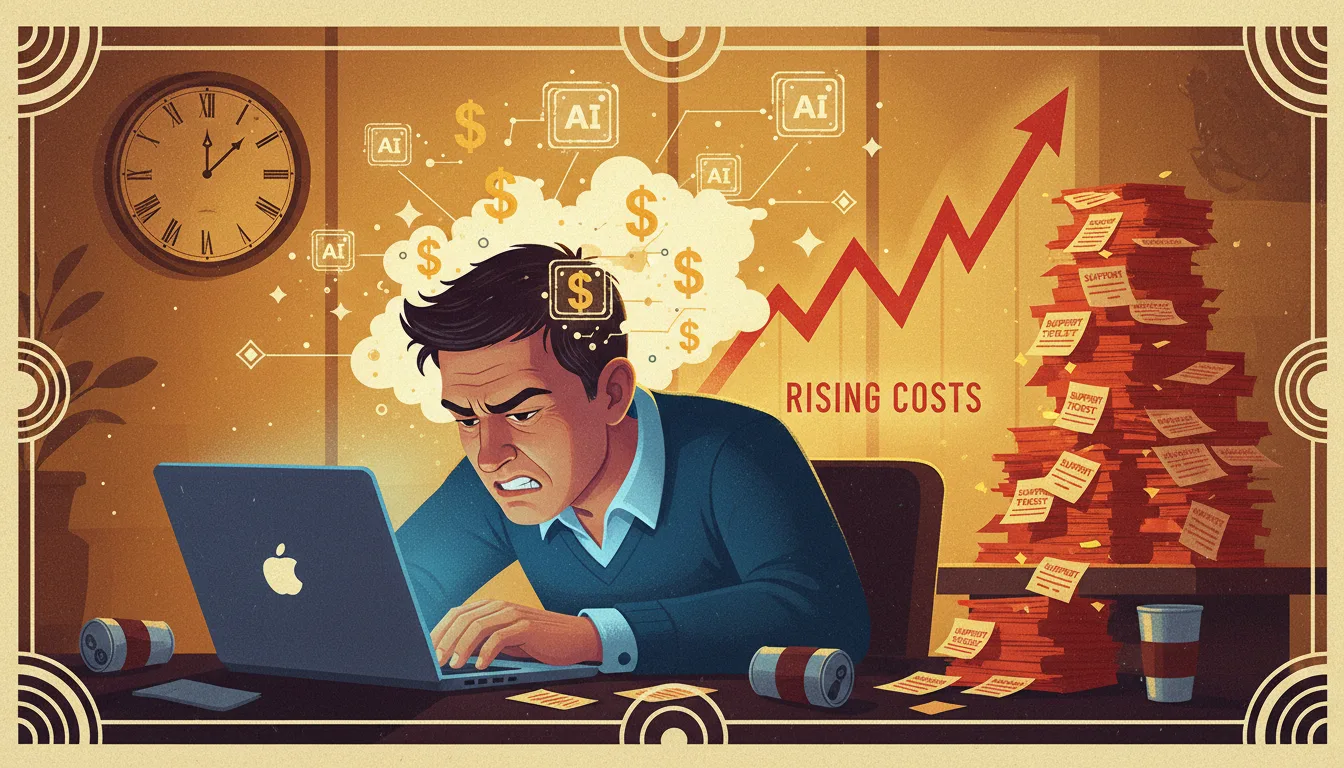
The pitch is everywhere in 2026. Build an AI-powered SaaS. Set it up once. Let the money flow while you sleep. The YouTube thumbnails are consistent: someone reclining on a beach while their AI agent handles support tickets, generates content, and processes payments. The comments sections are full of people asking how to get started.
Reality tells a different story. The AI passive income dream is real as an aspiration, partially real as an opportunity, and frequently catastrophic as a business model when built on the assumptions the content industry promotes.
Why Everyone Suddenly Wants Passive Income (It's Not What You Think)
The passive income gold rush of 2026 isn't primarily driven by greed. It's driven by fear. Something more psychologically complicated than simple ambition is at work: people are scared, and passive income has become the culturally sanctioned response to economic anxiety.
AI job displacement concerns appear consistently across threads that have nothing to do with tech, in finance forums, creative communities, even trades discussions. The pattern: someone describes their current job, mentions noticing AI encroaching on their work, and pivots immediately to asking about passive income as an escape hatch. Not "how do I upskill" or "how do I move into adjacent work." The jump is directly to passive income as the solution to the threat of automation.
"AI is making me more productive but I worry it will replace me eventually. That's why I'm building passive income streams now while I still have a salary to fund them."
CS graduates are feeling this particularly acutely. The community captures repeated variations on a frustrating situation: people who invested four years and significant money into computer science degrees are finding that entry-level software roles have contracted sharply in 2026, partly due to AI tooling that makes smaller teams more productive, partly due to companies still recalibrating from 2024 and 2025 overhiring. The technical skills they developed to build software are, in many cases, exactly the skills the passive income content industry tells them to deploy for SaaS products. So the flight path makes intuitive sense even when the underlying economics don't support it.
Wage stagnation adds a separate pressure layer. Data from the conversations suggests that for knowledge workers feeling squeezed between flat salaries and rising costs, passive income represents not just additional money but a specific kind of freedom: money that doesn't require trading time. The aspiration is about the relationship to work, not just the amount of income.
The SaaS Passive Income Myth, With Receipts
The most concrete data in the passive income discussion concerns a specific narrative that has dominated creator content for three years: that building a small SaaS product with AI tooling is a path to genuine passive income. The community is starting to have the conversation that the content industry isn't.
"SaaS 'passive income' requires 20+ hours/week of active work, support tickets, maintenance, marketing never stop."
This comment and its variations appear across multiple threads and represent a growing consensus among people who have actually shipped products rather than those planning to. The mechanics are specific: when you launch a software product, even a simple one with AI-generated code handling most of the functionality, you inherit an ongoing operational burden that the "build it once" narrative systematically ignores.
Support tickets arrive immediately and continuously. Users find edge cases the builder didn't anticipate. Dependencies require updates. Platforms change APIs. Marketing content becomes stale. Payment processors occasionally flag accounts. None of this stops when the product launches. For a solo founder with a day job, "20+ hours per week of active work" isn't passive income: it's a second job that generates less money and more stress than the first one.
The content economy has incentives that point away from sharing this information. Tutorial creators earn affiliate income from the tools they recommend. Courses sell better when the outcome sounds achievable. The passive income dream content genre is a business in itself, and its business model depends on maintaining the aspiration.
What "Passive" Actually Means in 2026
The community data does contain a more nuanced signal underneath the frustration: the concept of passive income isn't invalid, but the definition being sold is. Real people who have found workable income streams outside traditional employment describe something different from the "build it once" narrative: they describe what might more accurately be called semi-passive income: activities that require significantly less time-per-dollar than employment, have some flywheel characteristics, and can be managed within realistic time constraints.
"Focus on semi-passive income streams that require 5-10 hours per week of management. That's genuinely different from a full-time job and worth pursuing."
The distinction is important. A digital product: a template, a dataset, a prompt library: that generates $500/month from an existing audience and requires 3 hours per week to support is genuinely different from employment. It's also genuinely different from the "earn while you sleep" content fantasy. People who approach passive income with this more calibrated expectation consistently find better outcomes than those chasing the purer version.
AI tools change this calculus in specific ways that the community identifies correctly. The time investment to create digital products, written guides, templates, simple tools, has dropped significantly. Content that once required 40 hours to produce can now be drafted in 4 hours with AI assistance, then refined for quality and personality in another 4. This doesn't eliminate the work; it compresses the production phase. The distribution, marketing, and support work largely remain. But for someone with domain expertise and an existing audience, this is a genuine efficiency improvement that makes semi-passive income more accessible than it was five years ago.
The Affiliate Marketing Trap
Affiliate marketing occupies a peculiar position in the passive income conversation. It's frequently promoted as the entry-level option, low barrier, no product to build, just drive traffic. The honest assessment is more precise.
Affiliate marketing is not passive at any meaningful scale. Building the audience required to generate useful affiliate income requires sustained content production: which is active work. Maintaining search rankings requires ongoing SEO effort: which is active work. When AI-generated content floods every niche, standing out requires quality and differentiation: which requires active, skilled work. The ceiling on passive affiliate income from a one-time content investment is low; the floor on the work required to make it meaningful is high.
Where AI tools change the affiliate picture is in the speed of testing. Someone with a clear niche and existing audience can now produce and test content formats much faster than before. The passive income ceiling doesn't change, but the experimentation velocity does. For people who are willing to treat this as a real business with real operational demands, that's a genuine advantage. For people expecting the "set it up and let it run" outcome, it's not.
The Opportunity the Community Is Actually Describing
Strip away the frustrated reality checks and a clearer picture of what the community is actually looking for emerges. The demand signal is specific: people want income opportunities that are honest about their requirements, don't overpromise the passive element, and leverage AI tools in ways that genuinely reduce time-per-dollar rather than just re-labelling active work as passive.
The real gap isn't about any specific income method: it's about information quality. Builders are sophisticated enough to recognise when passive income content is selling a dream. What's actually needed is specific, realistic guidance: here's what this method actually requires per week, here's a realistic income range, here's where the friction points are, here's who it works well for and who it doesn't.
"I never thought I could make money from my hobby until I tried focusing on a small audience who actually valued what I knew. AI tools helped me produce content faster. But it was still work, just more enjoyable than my job."
The AI tools' actual role in the picture, as the community understands it, is as an accelerant for people who have genuine expertise or distinctive perspective to share. Not a shortcut past the need for either of those things. Someone with deep knowledge of a specialised domain can now produce useful content about that domain much faster than before. The audience still needs to exist or be built. The expertise still needs to be real. The distribution work still needs to happen. But the production friction drops meaningfully for people who have the other elements in place.
What to Do If You're Building in 2026
Three principles distinguish the people finding workable outcomes from those accumulating frustration.
First: start with the active work, then reduce it. The most successful trajectories in the data start with a service, consulting, freelancing, direct skill application, and then systematically productise and automate it over time. The passive income outcome is the destination of a journey that begins with active work, not a starting point. Trying to skip the journey by building products for problems you haven't directly experienced produces the frustration the data documents.
Second: take the 20+ hours/week estimate seriously. If you're evaluating a passive income path, the right question isn't "can I build this?" but "can I sustainably operate this at the time cost it actually requires?" For someone with a day job, a second job that generates $800/month might be worth it. One that generates $800/month but requires 25 hours/week might not be. Do the honest maths before committing.
Third: AI tools reduce production friction, not expertise requirements. The clearest wins in the data involve people who used AI tools to produce more quickly in areas where they had genuine knowledge. The clearest failures involve people who used AI tools to produce quickly in areas where they had no particular insight to offer. The quality signal audiences respond to comes from the human knowledge behind the content, not the speed at which the content was generated.
Key Takeaways
- AI job anxiety is the primary driver of passive income interest in 2026, fear of displacement, not greed, is pushing people toward alternative income streams.
- SaaS "passive income" requires 20+ hours/week of active work. Support, maintenance, marketing never stop after launch. This is a second job, not passive income.
- The realistic frame is "semi-passive" income: 5-10 hours/week management, genuine flywheel characteristics, less time-per-dollar than employment, not "earn while you sleep."
- AI tools genuinely reduce production time for people with real expertise. They don't substitute for expertise, audience, or distribution work.
- The most reliable path: start with active service work in your area of expertise, then productise and automate incrementally. Don't start with the product.