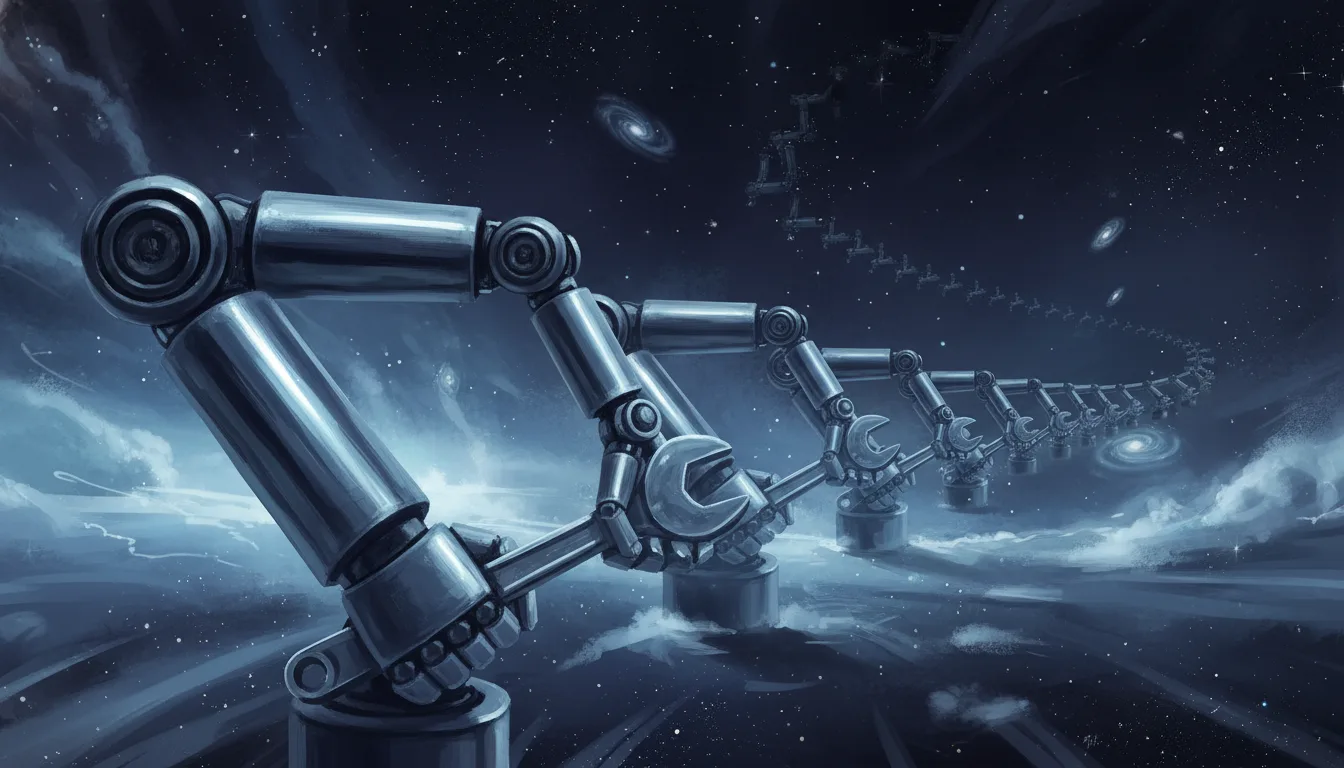
My prediction is by the end of 2028, it's more likely than not that we have an AI system where you would be able to say to it, "make a better version of yourself," and it just goes off and does that completely autonomously.
- Jack Clark, co-founder of Anthropic, speaking publicly in 2025Jack Clark spent years at OpenAI before co-founding Anthropic with Dario and Daniela Amodei. He is not a person inclined toward hype. The entire institutional identity of Anthropic is built on the premise that AI development is dangerous and needs to be approached with more caution than the industry has historically applied. When a man whose career is predicated on that concern says the odds are better than even that AI will be building itself within 1,000 days, and says he finds the view uncomfortable, it's worth taking seriously.
What "AI Builds Itself" Actually Means
The phrase "AI self-improvement" carries a lot of science-fiction baggage, recursive superintelligence, runaway intelligence explosions, the singularity. Clark's prediction is more concrete and more near-term than any of those framings. He's describing a specific capability threshold: an AI system that, when instructed to improve itself, can autonomously navigate the full software engineering pipeline required to produce a better version of its own architecture, training procedure, or evaluation suite.
This requires the AI to:
- Understand its own codebase, training pipeline, and evaluation harnesses
- Identify specific improvements, architectural, algorithmic, or data-related
- Implement those improvements without human guidance
- Evaluate the results and iterate
- Produce a model that actually performs better than the original
Two years ago, this would have required teams of PhD researchers working for months. Today, Claude Code can already handle large-scale autonomous software engineering. The question Clark is asking is whether, within 1,000 days, that capability will extend to the specific domain of AI development itself.
The Benchmarks That Make the Prediction Credible
Clark's prediction isn't speculation, it's extrapolation from a benchmark trajectory that has been running since 2023. The numbers are stark.
Multi-step autonomous tasks
Real GitHub issue resolution
Data science vs. human experts
Research-level mathematics
The CoreBench trajectory is particularly relevant to Clark's prediction. CoreBench measures an AI system's ability to complete complex, multi-step autonomous tasks in real computing environments, the same class of capability required for self-improvement. In early 2024, the best systems scored 21%. By early 2026, the top score is 95.5%. If you drew a line through that trajectory and extended it 1,000 days, you'd be very close to Clark's prediction without any additional assumptions about architectural improvements or new training approaches.
Terence Tao's Threshold Statement
Jack Clark isn't alone in making predictions that would have seemed extreme a few years ago. Terence Tao, the Fields Medal-winning mathematician widely considered one of the greatest mathematical minds alive, has publicly stated that AI crossed the mathematical discovery threshold at the end of 2025.
"By the end of 2025, AI had crossed the threshold from mathematical calculation into mathematical discovery."
- Terence Tao, Fields Medal laureate in mathematicsMathematical discovery, not just solving known problems, but identifying new theorems, conjectures, and proof strategies, has historically been considered the domain of human creativity and intuition. It's the kind of task that seems deeply unlike autocomplete. Tao's statement suggests the boundary has already moved further than most people outside the research community realize.
This matters for Clark's prediction because self-improvement is fundamentally a research problem. Improving an AI system's architecture, training procedure, or evaluation harnesses requires exactly the kind of creative problem-solving that Tao says AI has begun to demonstrate. If AI can make mathematical discoveries, the distance to "make a better version of yourself" is shorter than it was.
The 3D Printer Metaphor
Clark uses an analogy to explain what AI self-improvement would actually mean in practice, and why the framing of "runaway recursion" misses the point.
The first 3D printers couldn't print their own parts well enough to replicate themselves usefully. As print quality improved, a 3D printer could produce components that improved the next generation's precision. AI self-improvement isn't a sudden discontinuity, it's the moment when the tool becomes good enough at the task of tool-making that the feedback loop becomes self-sustaining. You don't need a science-fiction intelligence explosion. You just need the capability to exceed the threshold where each iteration is meaningfully better than the last.
This framing strips away some of the science-fiction loading around AI self-improvement. It doesn't require a sudden jump to superintelligence. It requires AI systems to be good enough at software engineering, ML research, and evaluation design that the quality of AI-assisted AI research exceeds what human researchers produce in the same timeframe. Clark's claim is that this threshold is more likely than not to be crossed within about 1,000 days.
Why Clark Calls This a "Reluctant View"
The most striking part of Clark's prediction isn't the number, it's the affect accompanying it. He doesn't frame it as exciting. He frames it as something he finds difficult to sit with.
"It's a reluctant view because the implications are so large that I feel dwarfed by them."
- Jack Clark, co-founder of AnthropicThat sentence is doing a lot of work. "Dwarfed by them" is not the language of someone selling a technology. It's the language of someone who has thought carefully about what they're predicting and found the implications unsettling, not catastrophically bad, but large in the sense that they exceed the frameworks most people use to think about the future.
Consider what a 60%+ probability of AI self-improvement by 2028 implies for:
- Research careers, PhD programs in machine learning last 4-6 years. Students starting today are training for a job market that may be fundamentally restructured before they graduate.
- Compute investment, If AI systems can improve themselves autonomously, the value of current GPU infrastructure depends heavily on what the next generation of AI chooses to optimize for and how fast that happens.
- Safety research timelines, Anthropic's entire justification for its existence is that there's time to do alignment research before dangerous AI systems are built. A 60% probability of self-improving AI by 2028 compresses those timelines significantly.
- Policy and governance, Regulatory frameworks for AI are being written now. If they don't account for self-improvement as a near-term possibility, they may be obsolete before they're implemented.
The 40%: What Would Have to Go Wrong
Clark's 60%+ estimate is a probability, not a certainty. The remaining 40% covers scenarios where the prediction doesn't materialize by end-of-2028. What would those scenarios look like?
The most plausible failure modes for the prediction are technical rather than societal. Current benchmark trajectories could hit a wall, some cognitive tasks may require fundamentally different architectures that don't arise from scaling current approaches. The specific sub-skills required for AI self-improvement (understanding training dynamics, identifying architectural bottlenecks, designing better evaluation suites) may be harder than current trajectories suggest. The engineering complexity of deploying a genuinely better AI system autonomously, not just writing better code but actually running training, evaluating the result, and shipping, is substantial.
There's also the possibility that the threshold Clark is pointing at is higher than the benchmark extrapolation implies. SWE-Bench at 93.9% is impressive, but real-world AI research involves problems that aren't well-specified in advance, feedback signals that are noisy, and creative insight that doesn't reduce to any single benchmark score. The gap between "exceptional at defined tasks" and "can independently improve itself" may be larger than the current trajectory implies.
What 1,000 Days Actually Looks Like
From mid-2026, this is roughly the window Clark's prediction covers. In that time, the models that currently seem impressive will likely be viewed the way GPT-3 is viewed today: capable, but clearly early. The question Clark is asking is whether, at the end of that window, the systems being built will be doing the building.
Consider the benchmark trajectory over the past 1,000 days. In early 2024, SWE-Bench scores were in single digits. CoreBench didn't meaningfully exist as a benchmark. Claude 3 had just launched. The pace of improvement has not been linear, it has accelerated as each generation of models has been used to assist in the development of the next.
The next 1,000 days will unfold with models that are already capable of substantial autonomous software engineering as the baseline. The acceleration that produced the CoreBench trajectory from 21% to 95.5% will operate from a higher starting point, with more capable AI assistance in every part of the research pipeline, and with compute infrastructure that's scaling at rates that weren't planned for because nobody anticipated the demand.
The Uncomfortable Middle Ground
The hardest part of processing Clark's prediction is that it sits in uncomfortable middle ground between two more mentally manageable framings. Either AI self-improvement is impossible within the timeframe (which would let us dismiss it) or it's inevitable and imminent (which would trigger the full apocalyptic framing). Clark's 60%+ estimate denies both exits. It's not a certainty, so you can't plan for it as inevitable. But it's more likely than not, so you can't treat it as a remote possibility to be monitored from a comfortable distance.
That's why Clark finds it a reluctant view. It's not a comfortable probability to hold. It's large enough to require serious engagement, uncertain enough to resist simple responses, and close enough in time that the decisions made in the next few years are likely to matter.
The man who co-founded a safety-focused AI lab specifically because he was worried about what powerful AI could do is now predicting, with better-than-even odds, that we'll have self-improving AI within the decade he helped start the company to prevent harm from. He's not alarmed in a way that suggests he thinks it's necessarily bad. But he uses the word "dwarfed."
That word is worth sitting with for a moment.