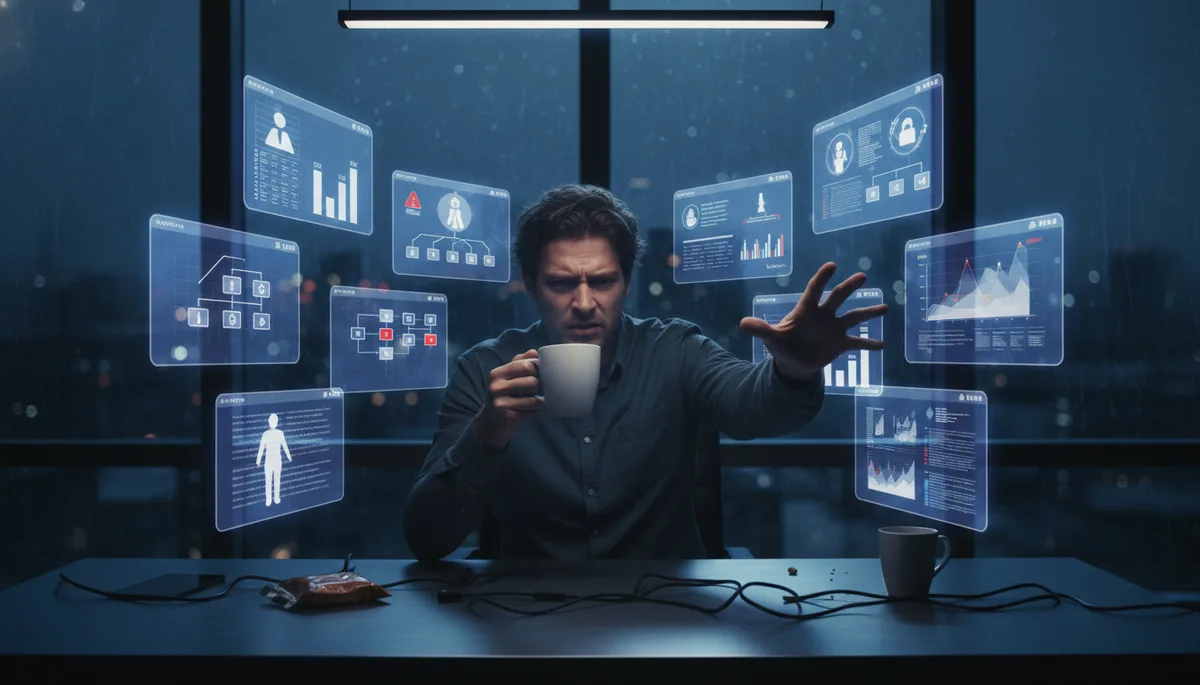
Here is the central irony of 2026: AI software is finally capable enough to genuinely help with hard work, and somehow that made things feel more complicated. You have more tools than ever. You are also, in some measurable sense, more responsible for more things than ever. The agents are capable. You are the stressed manager.
That sentence deserves unpacking, because it describes a real structural problem that the industry has not yet solved -- not a vibe, not a learning curve, but an architectural failure in how most agent products are designed.
The Three-Stage Frontier
The evolution of what AI can do has moved in recognizable stages. The companies that figure out stage three will have found the thing that ChatGPT found in 2022 -- not just a capable model, but a product people actually reach for.
For years this was the whole game -- better answers to typed questions. Search became conversation. The breakthrough was making knowledge accessible without requiring expertise to retrieve it.
The agent boom. Tools that browse the web, write code, send emails, call APIs. The answer, increasingly, is yes. But action without oversight creates its own overhead -- and that is where most products are stuck today.
The unsolved frontier. Most agent products answer yes to stage two and sidestep stage three entirely. They are capable of action. What they require in exchange is your sustained attention: opening a session, assigning a task, monitoring progress, nudging agents when they stall.
What OpenAI's Engineers Found Out the Hard Way
OpenAI's internal Symphony protocol is one of the most honest data points on this problem. The engineering team had fast coding agents -- genuinely useful, capable of multi-step tasks. And they still hit a wall. The wall was not the agents' performance. It was human attention. The issue tracker became the source of truth -- the place where work lived when no human was actively touching it.
People were spending meaningful time just managing the agents: opening sessions, assigning work, checking on progress, nudging things that had stalled, restarting tasks that had failed silently. The agents were fast. The humans were becoming project managers for machines, and it was wearing on them.
Symphony's fix was to remove that layer. Work moves into an issue tracker. Agents pick it up, work on it, and surface outcomes. Humans review results rather than supervising process. The shift sounds small. In practice, it relocates the cognitive load from the middle of the task -- where you have to stay engaged -- to the end, where you can evaluate on your own schedule. That is not a feature. That is a different product philosophy.
The Proactivity Problem
There is a name worth coining for what most agents are missing: the anticipation gap. Current agents are reactive by design. You open them, tell them what you want, they try to do it. That structure sounds like agency. It is not, really.
The hardest part of getting anything done is not executing the task. It is noticing the task exists, remembering that a tool could help, translating what you need into a prompt, deciding how much permission to grant, and then supervising the output. For a task that would take you two minutes to do yourself, that overhead can easily exceed the time saved. The agent did the work. You did everything else.
"A tool waits for you to remember it. An assistant reduces the number of things you have to remember."
That distinction is load-bearing. Most agent products are sophisticated tools. Almost none of them are assistants in the meaningful sense -- things that operate on your behalf without requiring you to prime them first.
Why ChatGPT Worked and Agents Haven't (Yet)
ChatGPT's breakout success was not just capability. It was borrowed UX. Type a query into a box, get an answer back. That interaction pattern had 20 years of muscle memory behind it from search engines. Users already knew what to do the moment they saw the interface. Adoption did not require behavior change -- it required pointing existing behavior at a better destination.
Agents do not have that advantage. There is no inherited muscle memory for "open a session, assign a task to an AI, grant it the right permissions, check back later." That sequence has to be learned, practiced, and integrated into a workflow that was built without it in mind. For developers and power users, that learning happens. For everyone else, it is a significant barrier.
GitHub is planning for a 30x increase in repositories driven by agent-generated code. Stripe is seeing exponential growth in agent-driven business starts. The infrastructure is scaling to accommodate an agent-saturated world. The interaction model has not caught up.
Where The Industry Is Pointing
A few directions are worth watching. AWS is now building managed agents with identities, logs, and production controls -- treating agents more like services than sessions. That is an enterprise bet on agents that run continuously, not on demand. OpenAI's workspace agents operate in cloud environments, work in Slack, run on schedules. The pattern there is similar: reduce the number of times a human has to initiate something.
On the consumer side, clicky.so is taking a different angle entirely. Built on computer-use models, it puts a small blue cursor in the corner of your screen that executes tasks described in plain English -- browser navigation, form-filling, repetitive sequences. You can spin up ten of them in 30 seconds. Battery drain is a real tradeoff. But the interface collapses the prompt-permission-supervise cycle into something much closer to pointing and describing.
None of these are complete answers. They are indicators of where the pressure is being applied.
The Life Admin Problem
The consumer case is harder than the enterprise case for a specific reason: there is no compiler for correctness in ordinary life. When a coding agent makes an error, the tests fail. The feedback loop is tight and unambiguous. Did the agent book the right flight? Did it write the email in the right tone? Did it handle the calendar conflict the way you would have handled it? There is no test suite for life admin. Verification falls back to you, which means supervision falls back to you, which means the overhead never fully disappears.
The proactive vision that keeps getting described in product roadmaps goes something like this: an agent that notices your flight was delayed before you do. That sees the email from your child's school and flags that the permission slip needs a signature by Friday -- then looks at your packed calendar and suggests when. That spots the tense work thread and drafts a de-escalation reply before you have opened the message. Not because you asked, but because the situation called for it.
That vision requires something agents mostly do not have yet: the judgment to know when to show up, when to ask, and when to stay quiet. An agent that interrupts constantly to report on everything it noticed is just a different kind of management overhead. The hard design problem is calibrating the threshold -- high enough to be useful, low enough not to become another source of noise.
The Gap Is a Product Gap
Consumer demand for this kind of help is not in question. Capability, in a raw technical sense, is not the constraint either. The models can do the work. The infrastructure is being built. What is missing is the layer between capability and usefulness -- the product decisions about when to act, what to surface, how to hand off, and how to stay out of the way.
The enterprise path to solving this looks like Symphony: move the management overhead out of the human's moment-to-moment attention and into structured workflows with async review. The consumer path looks like something that does not fully exist yet -- an agent that earns trust gradually, learns what you would want surfaced, and reduces the number of things you have to track rather than adding one more dashboard to your rotation.
The companies that figure out question three -- can AI do useful work without creating a new management layer -- will have found the thing that ChatGPT found in 2022. Not just a capable model. A product people actually reach for.