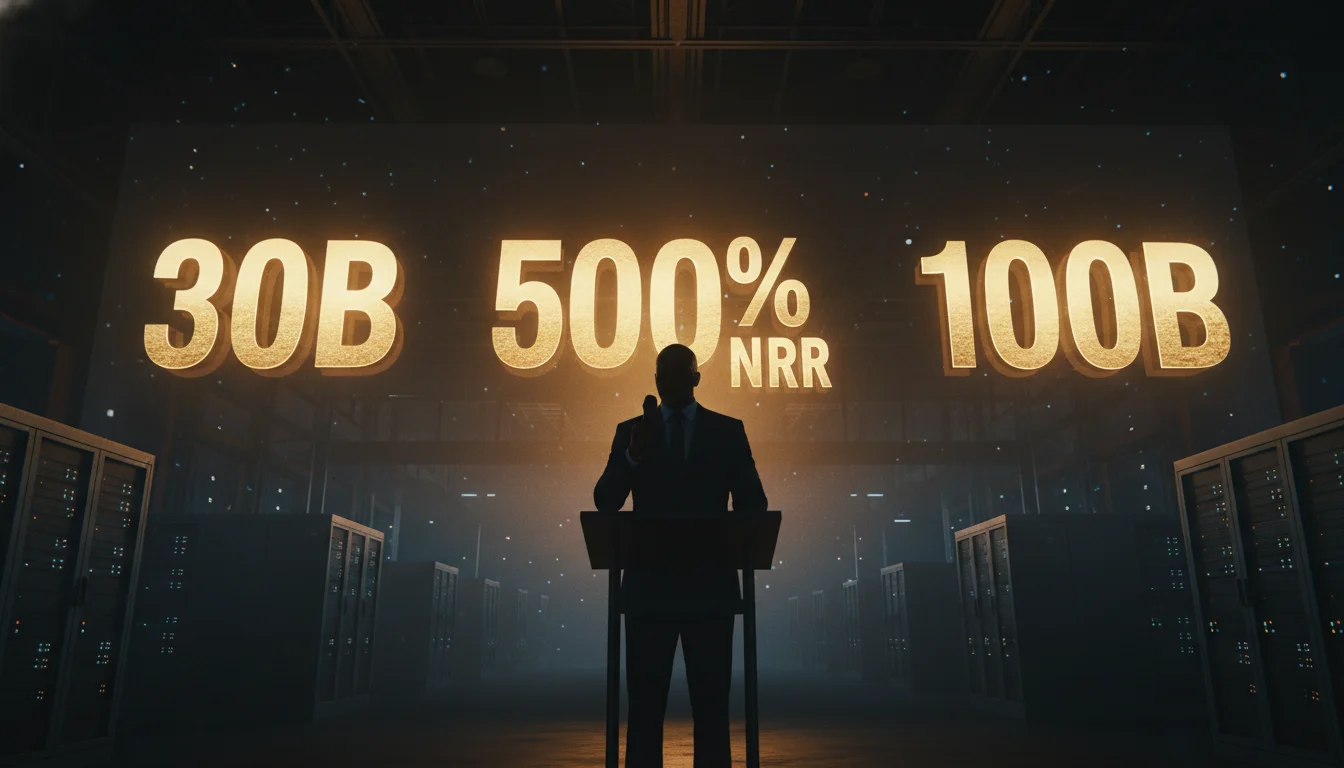
CFOs don't usually talk like this. When Anthropic's CFO Krishna Rao took the stage, he opened with a revenue figure that stopped the room. The company that started the year at $9 billion annualized run rate ended "north of $30 billion" within a single quarter. That is not a rounding error. That is a company tripling in three months. And the numbers that followed — on compute spend, on enterprise retention, on the talent war — painted a picture of an industry where the economics have permanently decoupled from anything investors' spreadsheets expected.
The Quarter That Rewrote the Rules
Rao put the number on the record without hedging: "We started the year with about $9 billion of run rate revenue and ended north of $30 billion." For context, this is the fastest revenue ramp any enterprise software company has publicly disclosed at anything approaching this scale. Legacy SaaS giants measured their best-ever quarters in double-digit percentage gains. Anthropic just posted a 230%-plus jump in a single quarter.
The customer penetration numbers are equally blunt. Nine of the ten Fortune 10 companies — the ten largest companies in the United States by revenue — now run Anthropic in production. That is not a pilot program. That is operational dependency at the highest tier of global enterprise. Rao acknowledged the forecasting implications directly: the team had to "constantly re-forecast" because standard models, built on historical software adoption curves, simply break at this rate of expansion.
The product driving the bulk of the growth is Claude Code. Not Claude as a writing assistant or a summarization tool. Claude Code, which now writes more than 90% of code at the enterprises that have fully deployed it. The framing matters: not "assists with," not "accelerates." Writes. Human engineers review the output. The inversion — from human-writes-machine-reviews to machine-writes-human-reviews — happened faster than anyone on the product team predicted. It is also the mechanism behind every other number Rao disclosed.
Compute as Capital, Not Cost
The most consequential reframe in Rao's presentation had nothing to do with revenue. It was about how to think about compute spend. In the traditional enterprise technology model, infrastructure is an operating expense — it scales with usage, it can be optimized, it can be cut in a downturn. Rao explicitly rejected that framing. Compute, in the AI training context, is a capital allocation decision with binary outcomes.
"If you buy too much compute, you go out of business. If you buy too little compute, you fall behind and someone else wins the market. There is no comfortable middle."
Krishna Rao — Anthropic CFOThe numbers behind this framing are staggering. Anthropic spent over $100 billion on compute in a single month during its heaviest training run. Against $75 billion raised to date — the majority absorbed by compute spend — the company is essentially running a capital-intensive infrastructure business that happens to produce language models as its output.
The underlying economic logic is defensible, if brutal. Train an extremely expensive model once; inference revenue scales without proportional cost increases. Each new enterprise customer paying for Claude API access or Claude Code seats adds revenue at high incremental margins. But you have to survive the training cost first. This is why the venture math makes sense to investors even at these numbers: the compute investment is a one-way door. There is no half-measure, no strategic retreat to a smaller model that captures meaningful market share. You either win big or the spend was waste.
The 500% NRR Nobody Is Talking About
Net Revenue Retention above 500% means that customers who signed contracts last year are now spending five times more than they did at signing. To calibrate: best-in-class SaaS businesses — the ones that analysts describe as having exceptional retention — operate at 120 to 130% NRR. Snowflake's peak NRR, celebrated across the industry, touched 168%. A 500% NRR is not a better version of normal. It is a different category of product relationship.
Rao's explanation for how this happens is structurally important. Enterprises start with Claude for a single use case — legal document review, customer support, internal knowledge retrieval. They get results. Within the same quarter, they expand to ten use cases. Then Claude Code lands in the engineering org and the calculus changes entirely: suddenly the product is not supplementing the engineering budget, it is consuming the engineering budget. Every dollar previously allocated to software development headcount becomes a potential Claude Code seat.
This NRR dynamic also explains why Anthropic doesn't need aggressive new logo acquisition to sustain growth. The existing customer base is compounding independently. Each customer is on a trajectory that, if left uninterrupted, ends with Claude as the primary operational software layer across the business. On the talent side, Rao disclosed that only two engineers had been poached by Meta — compared to dozens lost at other AI labs. He framed this as an organizational health indicator. Given the retention numbers on the customer side, the retention numbers on the employee side tell a consistent story about organizational gravity.
How Anthropic Runs Itself on Claude
One of the more striking disclosures from Rao was operational rather than financial: Anthropic is its own largest Claude Code customer. More than 90% of the company's own software is written by Claude Code and reviewed by engineers. This is not a marketing claim designed to signal product confidence. It is operational reality — and it creates a structural feedback loop that competitors running on conventional engineering pipelines cannot replicate.
When Anthropic's own engineers encounter a failure mode, a latency issue, or an edge case in Claude Code, that signal reaches the product team in days. In a conventional software organization, customer feedback travels through support tickets, account managers, quarterly business reviews, and product prioritization cycles. The lag between a customer experiencing a problem and an engineer fixing it is measured in months. Rao's point was direct: internal deployment compresses that loop to near-zero. The product gets better faster because the people building it are the people using it under production conditions.
There is a secondary economic consequence. Because Claude Code is writing the majority of Anthropic's own software, the company has been able to grow revenue at this pace without the proportional headcount growth that would typically accompany it. The engineering cost structure has been partially replaced by inference costs — which are, by definition, already accounted for in the model that generates the revenue.
The Exponential Forecasting Problem
Rao gave an unusually candid admission about the limits of financial modeling at Anthropic's current growth rate. Standard enterprise forecasting assumes an S-curve: rapid early adoption followed by a plateau as the addressable market fills. The model works because the behavior of customers converges toward a stable equilibrium — they buy what they need, they use what they buy, they don't dramatically expand without a new sales motion.
What Anthropic is observing is a different shape. Growth accelerates as customers go deeper into the product because each new use case creates demand for the next. Rao described the forecasting failure directly: "We were tracking quarterly forecasts and they were wrong every quarter, always low, by an order of magnitude." The implication for market sizing is significant. Every TAM estimate currently circulating for enterprise AI was produced before the 500% NRR pattern was understood. Those estimates assumed customers would behave like SaaS customers. They are not behaving like SaaS customers.
What This Means for Everyone Else
The economics Rao described create a specific and self-reinforcing competitive dynamic. Anthropic earns more from inference as the customer base expands at 500% NRR. That inference revenue funds the next training run. The next training run produces a better model. A better model attracts more enterprise customers. Those customers expand at 500% NRR. The loop compounds. For any competitor attempting to enter this market or close the gap, the structural problem is sequential: you cannot match the training spend without the revenue, you cannot get the revenue without the better model, and you cannot get the better model without surviving the training spend first.
For enterprise buyers, the situation Rao described is arriving faster than most procurement teams have processed. A vendor relationship where Claude Code writes 90% of your software is not a vendor relationship in any conventional sense. It is infrastructure. The switching costs are not contractual — they are operational. Migrating away from a system that writes your software requires re-staffing the engineering function that the system replaced. That is not a quarterly planning decision. That is a multi-year organizational reconstruction.
| Metric | Anthropic (2026) | Best-in-class SaaS | Implication |
|---|---|---|---|
| Revenue growth (QoQ) | 3x+ | 15–25% | Category-defining outlier |
| Net Revenue Retention | 500%+ | 120–130% | Infrastructure, not software |
| Compute as % of revenue | ~300%+ | <10% | Capital-intensive moat |
| Engineering headcount growth | Modest | Proportional | Claude eats its own costs |
| Customer concentration | 9 of 10 Fortune 10 | Distributed | Winner-take-most dynamics |
For market observers still applying bubble-cycle analysis to AI spending, the NRR figure is the most important data point to sit with. A bubble is characterized by demand that is speculative — spending that anticipates future value that may never arrive. When existing customers are expanding at 500% per year, that is not speculative demand. It is the opposite: it is demand that was underestimated at the point of sale and has since proven itself in production. The gap that matters is not between current valuations and current revenues. It is between current enterprise deployment levels and the level at which every major organization has reached full Claude integration. That gap is still enormous. The bubble, if there is one, is not in demand. It is in how slowly the rest of the enterprise world understands what full deployment actually looks like.
Related Reading
On the demand-side economics of the AI bubble: The AI Bubble's Missing Demand Problem. On how enterprise AI is reshaping organizational structures: The CEO Sycophancy Trap. On AI as company infrastructure: Your AI Skills Are No Longer Yours.