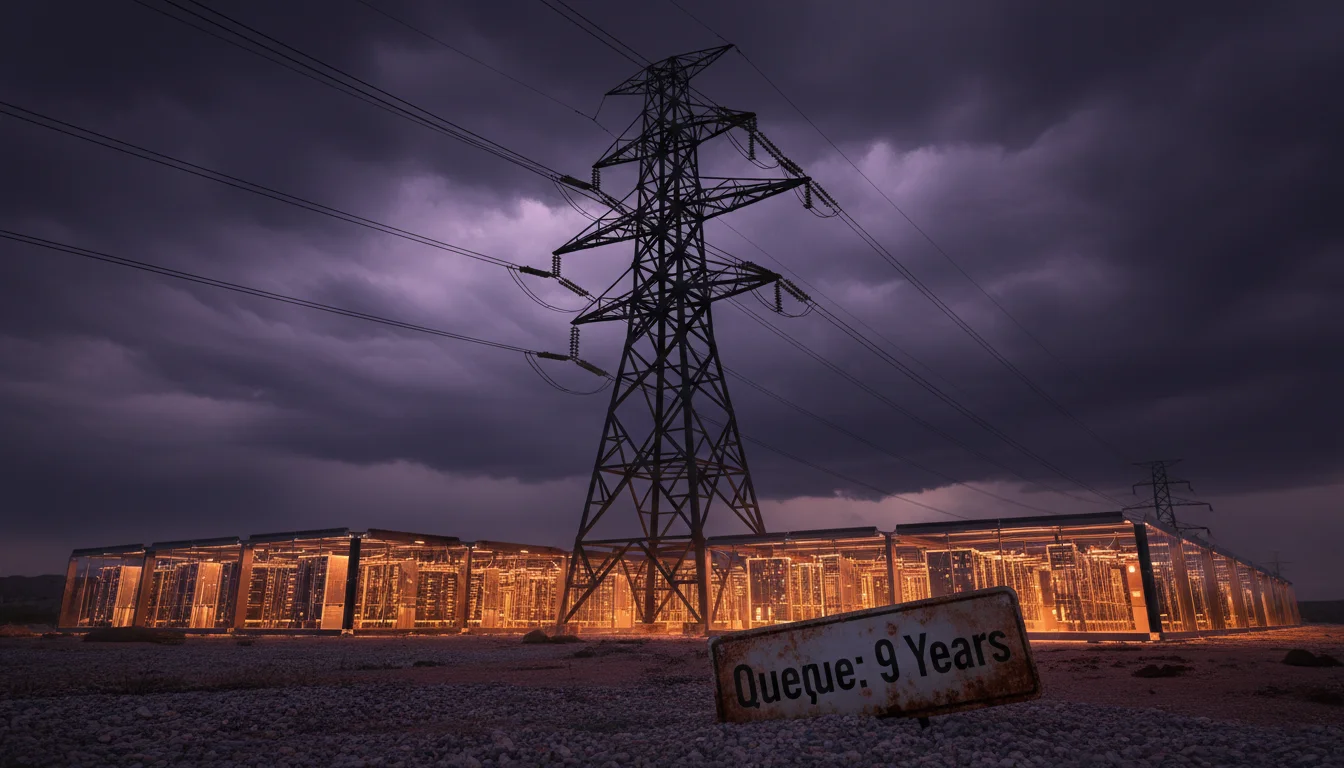
The conventional fear about AI hitting a wall centers on compute — either chips plateau, or training runs exhaust the available data, or some fundamental algorithmic ceiling appears. Physicist and science communicator Sabine Hossenfelder, who holds a PhD in theoretical physics and has spent years cutting through technology hype, has a different warning: the models may keep getting smarter, but by 2026 we may simply not be able to turn them on. The constraint is not algorithmic. It is infrastructural. The United States electric grid, and most grids in Europe, cannot connect new power capacity fast enough to keep pace with AI's energy appetite — and the queue to get connected stretches years into the future.
What the Wall Actually Is
When tech commentators talk about an "AI wall," they usually mean something happening inside the model — diminishing returns from scale, data exhaustion, or the limits of the transformer architecture. Hossenfelder's argument inverts this entirely. The wall she describes is external to AI research and entirely outside the control of any lab or chip vendor. It is the physical infrastructure of electricity generation and, more critically, the transmission grid that delivers that electricity to wherever it needs to go.
The International Energy Agency's most recent report projects that global data-center electricity use will roughly double between 2024 and 2030. That trajectory — approximately 15 percent annual growth — is four times faster than the growth rate of overall electricity demand. The IEA's numbers are not alarmist outliers. They represent a consensus forecast among energy analysts. And they collide directly with a grid that was not designed for this pace of change.
Morgan Stanley, which Hossenfelder cites as generally optimistic about AI's long-term prospects, nonetheless issued a notable warning: "Developers expect power constraints by 2027–2028 due to underinvestment in grids and potential supply chain disruption." The investment firm's phrasing is notable — this is not a pessimistic fringe view. It is the consensus expectation of the developers themselves.
The Grid Connection Queue Crisis
The specific mechanism driving the bottleneck is the interconnection queue — the formal process by which a new power plant or large energy consumer applies to connect to the transmission grid. According to data from Lawrence Berkeley National Laboratory, roughly 2 terawatts of power plant projects, renewable and otherwise, are currently waiting in that queue across the United States. Two terawatts is a staggering number: it represents nearly double Germany's entire electricity generation capacity, sitting idle in paperwork.
The median wait time for a grid connection is five years. In high-demand corridors — most notably Northern Virginia, which hosts the densest concentration of data centers in the world — that wait stretches to nine to twelve years. Northern Virginia is not a peripheral case. It is the epicenter of global cloud infrastructure. A nine-to-twelve-year connection timeline for new capacity in that region is not a minor inconvenience. It is a structural ceiling on AI deployment for the foreseeable future.
"The problem isn't just where all this energy is supposed to come from, but also how it will get to the data centres."
Sabine Hossenfelder, physicist and science communicatorThe causes of the queue backlog are multiple. Transformer shortages — the large electrical transformers used to step voltage up and down along transmission lines, not the neural-network architecture — play a meaningful role. Supply chains for high-voltage transformers are global, slow, and subject to geopolitical disruption. But Hossenfelder attributes the deeper cause to bad planning: decades of underinvestment in grid modernization, combined with permitting processes that were designed for a slower era of infrastructure growth.
The 2026 Data Center Gap in Numbers
The gap between announced ambition and physical reality became sharply visible in early 2026. Axios reported in February that as many as half of all data-center projects scheduled to come online that year could face significant delays. Of the more than 16 gigawatts of capacity in the pipeline, only 5 GW was actually under construction. The remaining capacity — more than 11 GW — sat in the "announced" stage with no active building underway.
| Category | Capacity (GW) | Status | Outlook |
|---|---|---|---|
| Data centers planned for 2026 online date | 16+ GW | Announced | Up to 50% face delays |
| Data centers actually under construction | 5 GW | Active build | On track |
| Announced but no construction started | 11+ GW | Pending | Grid connection not secured |
| US power projects in interconnection queue | 2,000 GW (2 TW) | Queued | Median 5-yr wait; NoVA 9-12 yrs |
Elon Musk, speaking in a January 2026 recording cited by Hossenfelder, framed the asymmetry in blunt terms. "The rate of AI chip production is increasing exponentially," Musk noted, "but the rate of electricity being brought online is..." — at which point Larry Fink supplied the answer: "10%, 5% a year, max." Musk's conclusion: "It's clear that very soon we're producing more chips than we can turn on."
Why This Is Harder Than Just Building More Renewables
A natural response to the energy gap is to point at the rapid buildout of solar and wind capacity and ask why that can't simply absorb the demand. The answer, as Hossenfelder explains, is that generation and transmission are separate problems. You can build a solar farm, but if the transmission line to connect it to the grid is five years away in a queue, the panels generate nothing useful in the interim. The 2 terawatt queue cited by Berkeley Labs includes a large share of renewable projects. The grid is the bottleneck, not the absence of zero-carbon generation ideas.
Building generation directly adjacent to a data center — effectively creating a private grid island — is technically possible but comes with severe operational, logistical, and financial penalties. Redundancy, maintenance, fuel logistics, regulatory compliance, and the sheer engineering complexity of managing isolated power at gigawatt scale all push costs and timelines sharply upward. It is not a scalable workaround.
Small modular nuclear reactors are the technology most enthusiastically promoted as a solution by the current US administration. Hossenfelder is unsparing in her assessment: every SMR project completed or attempted to date has run roughly a decade behind schedule and approximately a billion dollars over budget. Her summary — "small modular reactor currently means small expectations and modular delays" — reflects an engineering track record, not political preference. The SMR timeline does not close the 2027-2028 window that Morgan Stanley identifies as the crunch point.
What This Means for AI Lab Timelines
The implications for the major AI labs are concrete. Training runs for frontier models at the scale being planned — including the kind of 100-gigawatt-per-model figures floated by Leopold Aschenbrenner in 2024, a number Hossenfelder notes is roughly twice Germany's entire generation capacity — presuppose grid access that does not exist on any near-term horizon at that scale. Even at more modest projections, the data-center capacity needed to run inference at commercial scale is running directly into the queue problem.
The consequence is not that AI progress halts. Models can continue to be trained at current power levels, and efficiency improvements are ongoing. But the aggressive timelines — superintelligence by 2027, AGI deployments reaching billions of users, data centers measured in hundreds of gigawatts — all rest on energy assumptions that the physical grid cannot honor. The chips may be ready. The power may not be.
"The future may be bright, but we've got nowhere to plug it in."
Sabine HossenfelderChina appears to be a partial exception. Both Musk and Hossenfelder note that China is not facing the same grid connection delays, a fact that carries significant competitive weight. China's centralized permitting process, state-directed grid investment, and willingness to fast-track large infrastructure projects means its data center buildout is not subject to the same interconnection queue that is choking US and European expansion. The geopolitical dimension of a grid bottleneck is not abstract.
What Could Fix It — and When
There are two paths out of the bottleneck, and neither is fast. The first is grid modernization: streamlining interconnection permitting, accelerating transformer procurement, and directing capital at transmission infrastructure rather than generation alone. This is a multi-year, multi-trillion-dollar undertaking that requires regulatory reform at federal and state levels. Progress is possible but historical precedent suggests it moves slowly.
The second path is efficiency: AI chip manufacturers reducing the energy cost of training and inference per unit of useful computation. Hossenfelder identifies this as the most likely near-term response to the power constraint. If training a frontier model requires a fraction of today's energy, the queue problem diminishes proportionally. But efficiency improvements take time to compound, and the current trajectory has energy demand growing faster than efficiency can absorb it.
The market implication Hossenfelder raises is pointed. If chip efficiency eventually closes the gap, a large share of the data centers currently under construction will be stranded assets — completed but unable to find customers, or simply never finished. When that reality begins to filter into equity valuations and earnings guidance, the consequences for the broader technology sector could be severe. The AI infrastructure buildout is being priced as though the grid problem does not exist. The grid problem exists.