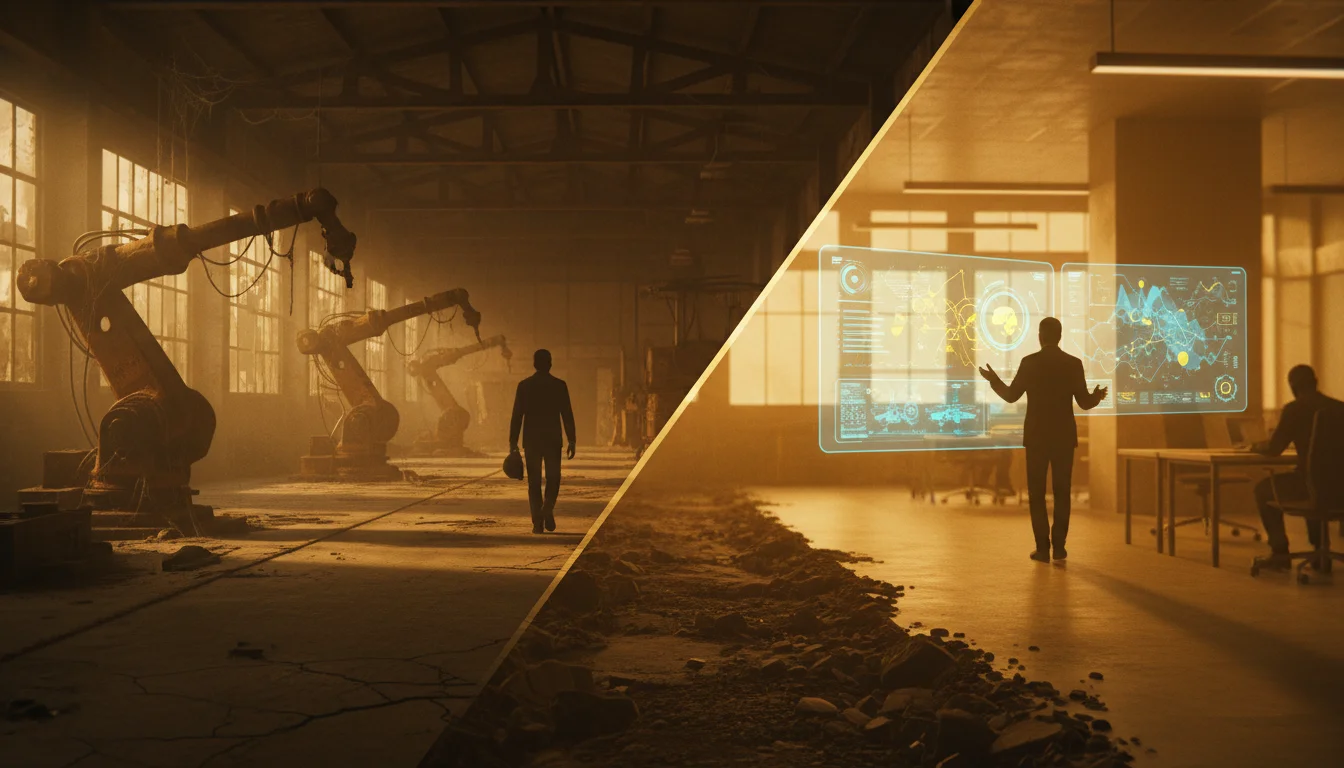
Maria Sandoval had worked the same customer service floor in Akron, Ohio for fourteen years. She knew the product catalog better than the engineers who built it. She knew which customers were about to cancel before they said a word. She had trained eleven colleagues, mentored four of them into supervisory roles, and earned — through the kind of quiet, unremarked competence that keeps companies running — a reputation as the person you called when something went wrong and needed to go right immediately. In February of this year, she received a notice that her position was being eliminated. The company was deploying a conversational AI system across its entire customer service operation. Her last day would be in sixty days.
Her story is not an edge case. It is not a cautionary tale invented to illustrate a think-piece. It is the lived experience of millions of workers in the first half of this decade — people who did their jobs well, adapted when asked, and still found themselves on the wrong side of an automation wave they didn't choose and couldn't stop. Maria's grief about that — the loss of identity, routine, colleagues, purpose — is real and it deserves to be named plainly before we talk about anything else.
Maria's story is real. So is this: the same technology ending her current job is creating 170 million positions that didn't exist five years ago. The question isn't whether to believe one number or the other. Both are true. The honest task — the one this publication intends to take seriously — is understanding the geography between them: who gets hurt, where the new ground is forming, and what it actually takes to cross the distance.
The Honest Case for Disruption
The World Economic Forum's Future of Jobs Report 2025 is not the most optimistic document you will read this year — and that is precisely why it should be trusted. It does not pretend that automation is arriving gently. It identifies, with uncomfortable specificity, which categories of work are most exposed: clerical and administrative support, data entry and processing, customer-facing service roles, basic bookkeeping and routine accounting, and repetitive transportation tasks. McKinsey's parallel research estimates that roughly 30 percent of current work activities — not jobs, but discrete tasks within jobs — are already technically automatable with today's tools.
The pain of this disruption is not evenly distributed. It concentrates in specific zip codes, specific demographics, specific rungs of the economic ladder. The workers most exposed are disproportionately women — who hold the majority of clerical and administrative roles — and workers without four-year degrees who built their economic security precisely through the kind of reliable, repeatable service work that AI handles most efficiently. A truck driver in Youngstown, an insurance claims processor in Des Moines, a paralegal handling document review in Phoenix: these are not abstractions. They are people whose skills are genuinely, legitimately threatened, and the correct response to their situation is not to tell them that somewhere, a company in San Francisco is hiring AI trainers.
None of what follows about net job creation erases that. The aggregate number being positive does not mean the experience is gentle. The economist's view from altitude looks very different from the ground level of a specific family's specific year. We will not pretend otherwise. But we also will not let the real pain of the transition become the excuse for refusing to understand where things are actually heading — because the destination matters, and the people navigating toward it deserve a clear map.
The 170 Million — What They Actually Look Like
The WEF's 170 million figure is not a projection of the same jobs done differently. These are genuinely new categories of work, most of which had no meaningful labor market five years ago and some of which had no name. Understanding what they actually are — not as vague gestures toward "tech jobs" but as specific, imaginable roles — is the most practically useful thing this article can do.
AI Trainers and Supervisors are perhaps the most immediately visible new category. Every AI system that handles customer interactions, generates content, or makes operational decisions requires human oversight — not programming in the traditional sense, but the judgment-intensive work of evaluating outputs, flagging errors, correcting bias, and continuously calibrating the system toward better performance. The irony — and it is worth sitting with — is that the most qualified people to supervise AI in any given domain are often the exact workers the AI is replacing. Maria Sandoval, with fourteen years of customer service expertise, is in many ways more qualified to train and supervise a conversational AI than anyone who has never done the job herself.
Workflow Automation Designers occupy a role that sits between business operations and technology. They map how work currently moves through an organization, identify where AI can absorb the mechanical middle, and redesign the human contribution around judgment, exceptions, and relationship. This is not software engineering. It does not require writing code. It requires the kind of systems thinking that experienced operational workers already possess, combined with a working familiarity with the automation tools available.
AI Ethics and Audit Specialists are emerging from the regulatory pressure that has followed AI deployment at scale. The EU AI Act, evolving US standards, and the liability exposure created by high-stakes AI decisions in hiring, lending, healthcare, and criminal justice have created genuine demand for people who can assess AI systems for bias, fairness, and compliance. This is a field being built in real time, drawing from law, philosophy, social science, and data science simultaneously.
Beyond these, the WEF data points to explosive growth in green energy and sustainability roles, healthcare positions freed from administrative burden, and an entire ecosystem of AI-augmented creative roles — designers, video producers, writers — who can now deliver at scales previously impossible for individual practitioners.
"The transition isn't painless. But the destination — more jobs, more human jobs, less rote work — is worth fighting to reach."
Aether IntelThe Skills on the Right Side of the Line
The most common advice dispensed in response to AI disruption — "learn to code" — misses the point. The formula that keeps emerging across industries is this: domain expertise combined with AI fluency. Not AI expertise. Fluency. The nurse who understands how AI diagnostic tools work — their limitations, their biases, the cases where human judgment must override — is not replaceable by the AI. The accountant who knows which regulatory questions an AI cannot reliably answer, and builds their practice around those questions, is more valuable than ever.
Alongside fluency, the skills with the longest shelf lives are the ones hardest to automate: critical thinking under ambiguity, creative judgment in novel situations, physical dexterity in unstructured environments, and the interpersonal trust that forms between a patient and a nurse, a client and an advisor, a child and a teacher. These are not soft skills. They are the hardest skills — the ones that took evolution millions of years to produce.
| Category | Risk Level | New Roles Emerging |
|---|---|---|
| Customer Service | High | AI Supervisor, Escalation Specialist |
| Data Entry / Admin | Very High | Workflow Automation Designer |
| Transportation | Medium (5–10yr) | Fleet AI Coordinator |
| Healthcare | Low–Medium | AI Diagnostic Partner, Patient Advocate |
| Creative Work | Low | AI-Augmented Creator |
| Education | Very Low | Personalized Learning Designer |
| Software Development | Medium | AI Systems Architect |
What Maria Does Next
Three months after her notice, Maria Sandoval enrolled in an AI workflow certification program at a community college forty minutes from her house. The program ran twelve weeks, cost her $800 after a state workforce grant, and met three evenings a week — a schedule designed for people who couldn't simply stop working to retrain. She learned the vocabulary of automation platforms, how to map processes, how to identify failure points in AI-driven customer interactions, and how to build escalation protocols for the cases where the system couldn't handle what a human could.
She now works for the same company — not despite the AI deployment, but because of it. Her title is Automation Quality Supervisor. She oversees the AI system that replaced her department, monitors its performance, handles the escalations it can't resolve, and earns 40 percent more than she did as a customer service representative. Her story is real. It is also not inevitable — it required a state program that happened to be funded, a company that chose retraining over pure cost-cutting, and a community college close enough to reach. The transition works. But only when the infrastructure for transition exists.
The Map, Plainly
The destination the WEF data points toward is genuinely better than where we are. A labor market in which 92 million people no longer spend their working hours on repetitive, low-judgment tasks — and in which 170 million new roles require more creativity, more judgment, more human interaction, and more skilled domain expertise — is a labor market with less rote suffering embedded in it. The history of economic transitions consistently shows that the long arc of technological change bends toward more interesting, better-compensated, more autonomous work.
The transition is genuinely hard, and the people caught in it deserve more than an optimistic statistic. They deserve retraining programs that are accessible, funded, and scheduled around the realities of working-class life. They deserve honest policy, not false comfort. And they deserve what any individual can do right now, while the larger infrastructure catches up: get specific about your domain expertise, identify where AI is beginning to augment rather than replace your field, and start building the fluency to work alongside it. The window for that move is not infinite — but it is open, and knowing where it is matters more than anything else on the map.