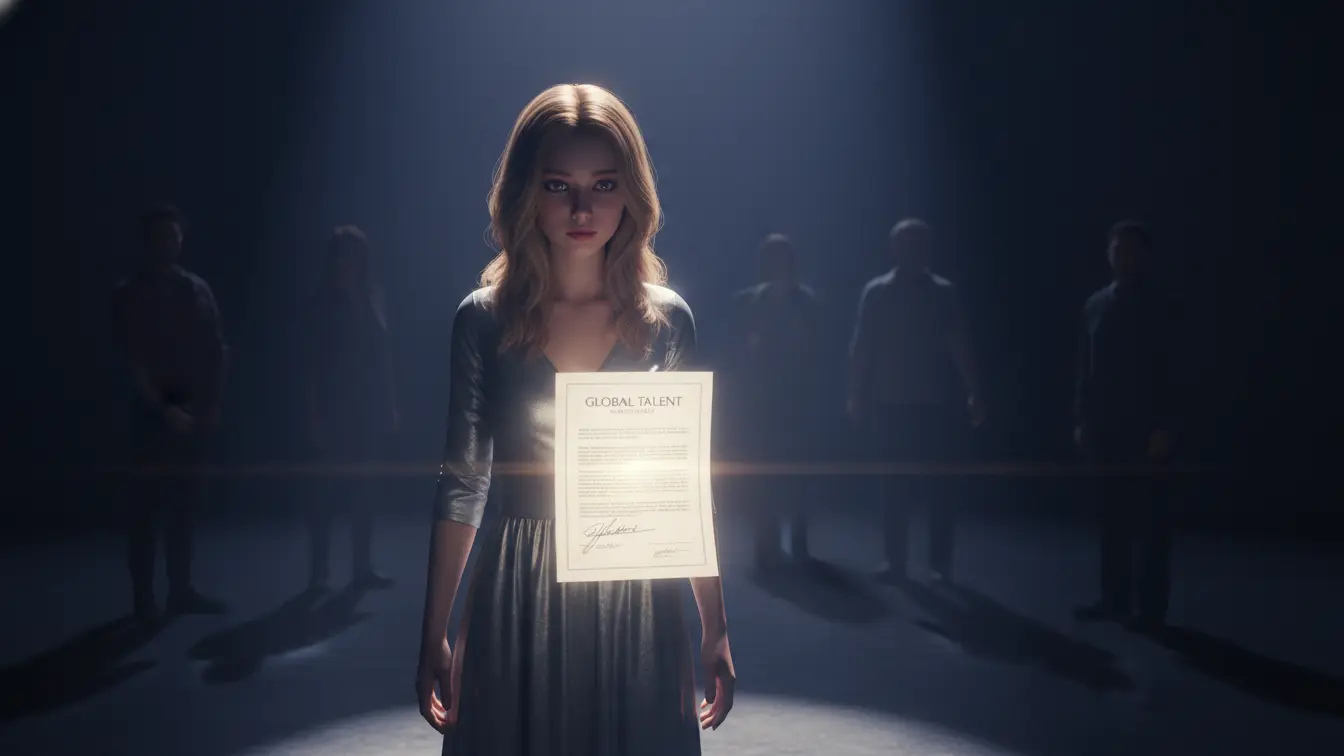
The announcement
At the Zurich Film Festival in late September 2025, Eline Van der Velden took the stage to announce that multiple talent agents were in talks to sign her newest client. The client had light brown eyes, golden blonde hair, a British backstory, and no biological existence whatsoever. Her name is Tilly Norwood, and she is an AI-generated actress produced by Van der Velden's studio Xicoia, a spin-off of her production company Particle6.
Particle6 has legitimate production credits: "Miss Holland" for BBC Three, "True Crime Secrets" for Hearst Networks, "Look See Wow!" for Sky Kids. Van der Velden is a working Dutch actress, comedian, and writer. What she announced at Zurich was not a publicity stunt. She described a product designed for long-term deployment: a hyperreal digital character with "complete backstories, distinct voices, evolving narrative arcs and fully realized personalities" and the ability to "engage in unscripted conversations, perform monologues, respond to trends in real time."
Her stated ambition for Tilly Norwood: "We want Tilly to be the next Scarlett Johansson or Natalie Portman."
The post about the announcement collected 6,676 upvotes on r/BrandNewSentence. The top comment, at 3,947 points, was three words: "Another nepo baby."
The resume
At the time of the announcement, Tilly Norwood had 19,000 Instagram followers. Her Facebook account had 16 friends. Her last Facebook post had drawn 10 likes and 4 comments.
Her sole acting credit was a comedy sketch called "AI Commissioner," produced by Particle6, described as "playfully exploring the future of TV development." When it was released, Norwood posted on Instagram: "Can't believe it... my first ever role is live! I may be AI generated, but I'm feeling very real emotions right now."
She was not available for follow-up questions.
Van der Velden did not name which agencies were in talks. She said an announcement would come "in the next few months" from September 2025. Melissa Barrera, who has appeared in several major film franchises, posted to her Instagram Story the same day the Deadline report went live: "Hope all actors repped by the agent that does this, drop their a$$. How gross, read the room."
Kiersey Clemons posted: "Out the agents. I want names."
No names have been confirmed.
This has happened before
In May 2020, Lil Miquela, a CGI virtual influencer created by L.A. startup Brud, signed with CAA as the agency's first-ever virtual client. CAA took her on for music, television, film, brand strategy, and commercial endorsements. CAA agent Adam Friedman said at the time: "We are excited to jump in and help her navigate the world of television and film." She had previously been at WME.
In May 2021, South Korean virtual influencer Rozy, created by Sidus Studio X, entered a co-management agreement with Seoul talent agency S:IM, expanding from social media into magazines and broadcast.
These were not small experiments. Virtual influencers as a category generated roughly $500 million in gross campaign spend and attributable retail sales in Q3 2025 alone, across brands including Prada, Dior, Calvin Klein, Cartier, and Samsung. The top performers have followings in the tens of millions. Lu do Magalu, a virtual influencer created by Brazilian retailer Magazine Luiza in 2003, had 32 million combined social media followers by 2025 and generated $2.5 million in sponsored content revenue from 74 Instagram posts in 2024 alone.
None of this is new territory. What is different about Tilly Norwood is the specific framing: she is not being positioned as a brand mascot or a social media personality. She is being positioned as a film and television actress, with an acting resume, an acting identity, and a talent agent to negotiate acting contracts.
Twenty-three years ago, Hollywood made a film about this
In 2002, Andrew Niccol wrote and directed "S1m0ne." Al Pacino plays a failing Hollywood director who, after losing his lead actress, uses a program called "Simulation One" to generate a computer-composed actress. He calls her Simone. The public becomes obsessed. She wins double Academy Awards for Best Actress. The director must maintain the fiction that she is real.
The film was a satire about Hollywood's worship of image over substance, about the public's desire to project meaning onto surfaces, and about what happens when the product is convincing enough that the source becomes irrelevant. It grossed $19.6 million on a $10 million budget and holds a 50% rating on Rotten Tomatoes.
The Reddit commenter who responded to the Tilly Norwood announcement with "No one remembers the film Simone" had identified something precise. The film treated this scenario as a dark satire. The Xicoia pitch deck treats it as a growth strategy. The thing that was paranoid speculation in a 2002 Hollywood film is a Zurich Film Festival panel in 2025.
What the actors said
The backlash from working actors was rapid and almost entirely public.
Simu Liu posted to Instagram Stories: "Movies are great but you know what would be better is if the characters in them weren't played by actual humans but by AI replicas approximating human emotion." Lukas Gage, sarcastically: "She was a nightmare to work with. She couldn't hit her mark and she was late." Odessa A'zion: "She threw coffee in my FACE." Trace Lysette: "She cut me in line at lunch one day and didn't even say excuse me." Toni Collette posted a screaming emoji. Ralph Ineson, on X, wrote two words: "Fuck off."
Brian Duffield, a screenwriter, offered a different kind of observation: "Pretty telling that the industry's first venture into this was to create a teenage girl they could control."
Jenna Leigh Green posted publicly: "Hey @sagaftra any thoughts here?"
SAG-AFTRA has not publicly responded to the Tilly Norwood announcement.
Where the union can't reach
SAG-AFTRA's 2023 deal with AMPTP, negotiated after the 118-day strike, established rules about digital replicas of performers: studios must get consent, must disclose intended use, must pay actors for the work the AI replica would have replaced. The union's AI framework covers "employment-based digital replicas" (created with a performer's participation) and replicas built from existing materials.
It also covers synthetic performers built from a specific named human actor's facial features, requiring consent from that person or their estate.
What it does not clearly cover is a character generated from composite data or generative imagery not traceable to any specific identifiable performer. If Tilly Norwood's face is built from a model trained on hundreds or thousands of source images without any single credited person, the current consent and compensation framework has no clear enforcement mechanism.
Mara Wilson, who starred as the child lead in "Matilda" in 1996, asked the question most precisely: "And what about the hundreds of living young women whose faces were composited together to make her? You couldn't hire any of them?"
Van der Velden's response to the backlash: "She is not a replacement for a human being, but a creative work, a piece of art. I see AI not as a replacement for people, but as a new tool, a new paintbrush."
The economics of signing software
The economics of representing a virtual actress are worth examining directly. A talent agent's commission is typically 10 to 15 percent of the deal value they secure. For a human client, there are scheduling conflicts, personal crises, salary negotiations, residual obligations under union contracts, and the risk that the client might give a bad interview or make a decision that affects their market value.
A virtual character has none of these. She cannot quit. She has no scheduling conflicts. She can be deployed simultaneously across markets and territories. She will not demand a raise. She is not a SAG-AFTRA member, which means the residual structure that protects working actors does not apply to her work.
For an agency, what is being signed is an IP asset with the framing of a person. The commission comes from whatever studio, brand, or platform Xicoia licenses Norwood to. The agent negotiates on behalf of the software that owns her character, not on behalf of her. There are no duties under SAG-AFTRA franchise agreements as they apply to human performers, because she is not a human performer.
A Reddit commenter put the structure accurately: "So basically, multiple AI agents exchanging emails at this point?" The creative supply chain from character generation to performance to management to licensing is at minimum partially automated at every stage. The human talent agent is the one node in the chain that has not yet been replaced.
What Duffield identified
Brian Duffield's observation deserves a slower reading: "Pretty telling that the industry's first venture into this was to create a teenage girl they could control."
Norwood's fictional backstory lists her birthplace as Waterloo, Portsmouth. She is presented as young. She cannot make demands. She cannot have opinions about how she is used. She has no legal standing to object to a contract. She cannot read the deal her agent is negotiating. She will perform whatever she is directed to perform, forever, without fatigue or protest.
Van der Velden is herself a working actress. She described creating Norwood as opening "fresh possibilities without taking away from live acting." But Mara Wilson's question is still unanswered: the real young women whose composite features may have built Norwood's face were not hired. They were, most likely, not compensated. They were probably not told.
The agencies in talks to sign Tilly Norwood know all of this. They are in talks anyway. The announcement will come, Van der Velden said, in the next few months.
That was September 2025. The film industry is still waiting.
Sources
- r/BrandNewSentence: "Multiple talent agents are reportedly in talks to sign AI actress Tilly Norward" — 6,676 upvotes, 251 comments
- Deadline: Talent agents in talks to sign AI actress Tilly Norwood — September 27, 2025
- Variety: AI actress Tilly Norwood, talent agents, Zurich Summit — September 27, 2025
- The Wrap: Actors react to Tilly Norwood announcement — September 29, 2025
- Variety: Lil Miquela signs with CAA as first virtual influencer client — May 2020
- SAG-AFTRA 2023 TV/Theatrical Agreement on AI digital replicas and synthetic performers
- S1m0ne (2002), dir. Andrew Niccol — referenced in Reddit thread