A Different Kind of Infrastructure
Every major technology transition has produced a concentration of power. Railroads, electricity, telecommunications, the internet. Each time, the question of who owns the infrastructure shapes everything downstream: who gets access, at what price, under what conditions, with what visibility into what you're doing.
Aaron Bastani's argument is that AI is doing something structurally familiar, but with a tighter concentration than any of the previous waves. The stack that matters, compute, energy, model weights, distribution, is converging toward five companies. And unlike railroads or telecoms, these companies have never been subject to the kind of public accountability structures that previous infrastructure monopolies eventually faced.
The question is not whether the technology is impressive. It is: who decides what it does, and who decided that they get to decide?
The Five Companies
The structure, as Bastani maps it, is not really about AI models. It is about who controls the layers the models depend on.
Microsoft and OpenAI together hold a position in compute and model capability that no other pairing matches. Microsoft's Azure infrastructure runs a substantial portion of OpenAI's training and inference. OpenAI's models are the primary reason enterprises are currently paying for Azure AI services. The two companies are financially intertwined in ways that make "competition" between them largely theoretical.
Google and Alphabet bring something different: the combination of compute scale and search distribution. Google doesn't just train models. It controls the primary surface through which most of the world accesses information online. Integrating AI into that surface is not a product decision. It is an infrastructure decision about how information flows.
Meta holds its position through social distribution and a deliberate strategy of releasing open model weights. Llama's releases have made Meta a central actor in the AI ecosystem without requiring Meta to win on model quality. Open weights means the ecosystem runs on Meta's architectural choices whether or not it's running on Meta's servers.
Amazon's position is pure infrastructure. AWS is the cloud layer most enterprises actually run on. Amazon doesn't need to win the model race if every model eventually runs on its compute.
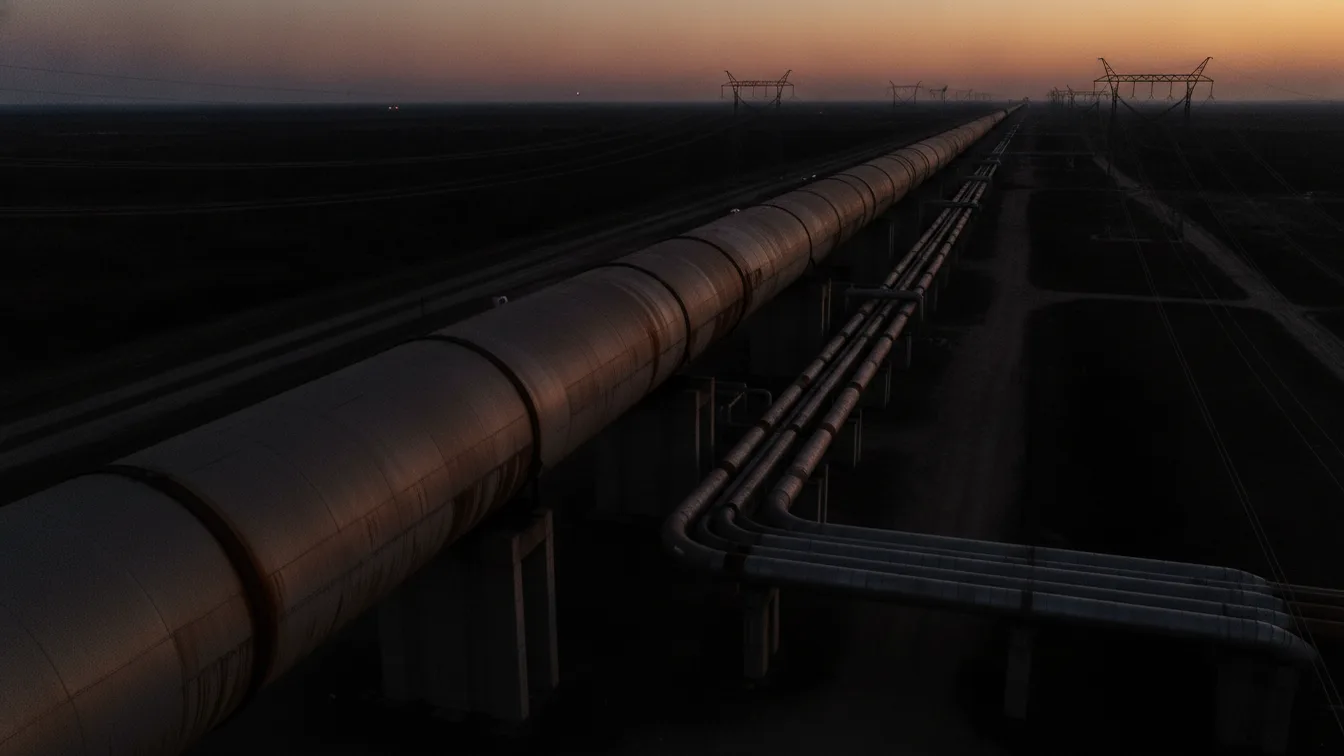
Nvidia is the hardware chokepoint. Not a cloud provider, not an AI lab, but the company that makes the hardware everything else depends on. Bastani's read: controlling the GPU supply is functionally equivalent to controlling a pipeline. Standard Oil's power didn't come from owning oil fields. It came from owning the infrastructure that moved oil. Nvidia owns the infrastructure that moves AI workloads.
The Energy Angle
The most underreported dimension of this concentration is energy. Bastani argues it is actually the most important one.
AI data centres consume power at industrial scale. The constraint on building more AI infrastructure is not primarily capital or expertise. It is power availability. Microsoft and Google are not, in a meaningful sense, buying GPUs. They are buying power purchase agreements. They are signing long-term contracts with utilities and energy producers to secure the electricity that the data centres will consume over the next decade.
Whoever controls the power supply for AI data centres controls AI. Not in the sense of controlling what the models say, but in the sense of controlling who gets to run models, at what price, and with what reliability. Power purchase agreements are not glamorous assets. They are also not things that competitors can easily replicate. Grid capacity, permitting timelines, and long-term energy contracts create a durable advantage that is harder to disrupt than software.
This is why the Microsoft-Constellation Energy deal for Three Mile Island matters as a signal. It is not primarily an energy story. It is a market positioning story about who will control the scarce input that determines who can train and run frontier AI.
The Democratic Deficit Argument
None of the five companies are democratically accountable for the decisions that matter most about AI deployment.
Which countries get access to frontier models, and on what terms, is a decision made by Microsoft's board and OpenAI's leadership, not by any elected body. What content moderation rules apply to AI-generated content on a given platform is a product decision made inside a private company. How much access costs, and therefore which organizations and individuals can afford to use it, is set by a pricing team. Whether a government or a company or an individual can use a frontier model to do a specific thing is decided by terms of service that can change at any time.
These are not small decisions. They are decisions about information access, economic participation, and in some cases national security. The people making them are accountable to shareholders. That is the entirety of their formal accountability structure.
The "move fast" defense that tech companies deploy against this argument runs roughly: government regulation would slow AI development and hand the lead to China. Bastani's response is that this framing treats the choice as binary when it is not. The question of whether to regulate is separate from the question of how fast to move. More importantly, the China comparison is doing significant rhetorical work in the argument: it frames any accountability mechanism as national weakness, which makes it very difficult to have a substantive conversation about what accountability should actually look like.
The Open Weights Counterargument
The most serious challenge to Bastani's concentration thesis is the open weights movement. Meta's Llama releases, Mistral's models, and a growing ecosystem of open-source AI development represent a real parallel track that is not controlled by the Big 5.
A developer in São Paulo can download Llama, run it on commodity hardware, and build applications without paying Microsoft or Google a dollar. That is a meaningful check on concentration. The open weights ecosystem has produced genuine capability and genuine diversity in who is building what.
Bastani's response acknowledges this and then narrows the argument. Open model weights don't solve the compute concentration problem. Training the next generation of frontier models requires compute that only the Big 5 can currently provide. The open ecosystem runs on previously released weights. The capability frontier, where the next set of weights will come from, is still a closed system. Open source can democratize access to existing capability. It cannot, by itself, democratize the process of generating new capability.
The pipeline analogy holds here too. Independent oil producers in the Standard Oil era could extract oil. They could not get it to market without using Rockefeller's pipelines. The open weights ecosystem can use the models. It cannot train the next generation of them without access to infrastructure that remains tightly held.
What Accountability Would Actually Look Like
Bastani's argument is often received as a call for government regulation, but that reduces the actual point. The decisions being made by these five companies are political decisions, and political decisions require accountability mechanisms, and none currently exist at the scale that matters.
The specific decisions Bastani points to: which countries get access to frontier models at what price, what usage restrictions apply and how they are enforced, what data is retained from user interactions and for what purpose, and whether access can be revoked at the company's discretion. Each of these is a decision with political and economic consequences that extends far beyond the company's own interests or its shareholders.
The EU's AI Act is the most significant attempt to impose external constraints on these decisions. Its critics argue it regulates the wrong things: disclosure requirements and high-risk use case restrictions rather than the infrastructure concentration Bastani identifies as the core issue. The Act does not address power purchase agreements or compute allocation. It regulates what companies can do with AI outputs, not who gets to build the infrastructure that produces them.
What accountability at the infrastructure level would require is harder to specify. Utility-style regulation with mandated access pricing. International bodies with actual enforcement authority over compute allocation. None of these are close to happening. The argument that they should is still in its early stages as a political project.
What This Lens Changes
The political economy frame doesn't tell you whether AI is good or bad. It doesn't tell you whether the Big 5 are acting in good faith. It offers something more specific: a way to read AI development decisions as infrastructure decisions, with all the implications that follow from that framing.
Infrastructure decisions are not primarily about the technology. They are about who controls access, at what price, on what terms, with what recourse for those who don't have access or don't like the terms. These are political questions. They have historically produced political responses: antitrust actions, public utility designations, regulated access requirements.
Whether AI infrastructure eventually gets treated this way is an open question. The regulatory apparatus in most countries is not currently built to handle it. The international dimension, AI is inherently borderless in a way that electricity grids are not, makes it harder still. But the question of how this infrastructure gets governed is not going away because the infrastructure is getting built whether or not the governance catches up.
The technology question and the power question are not the same question. It is worth keeping them separate.