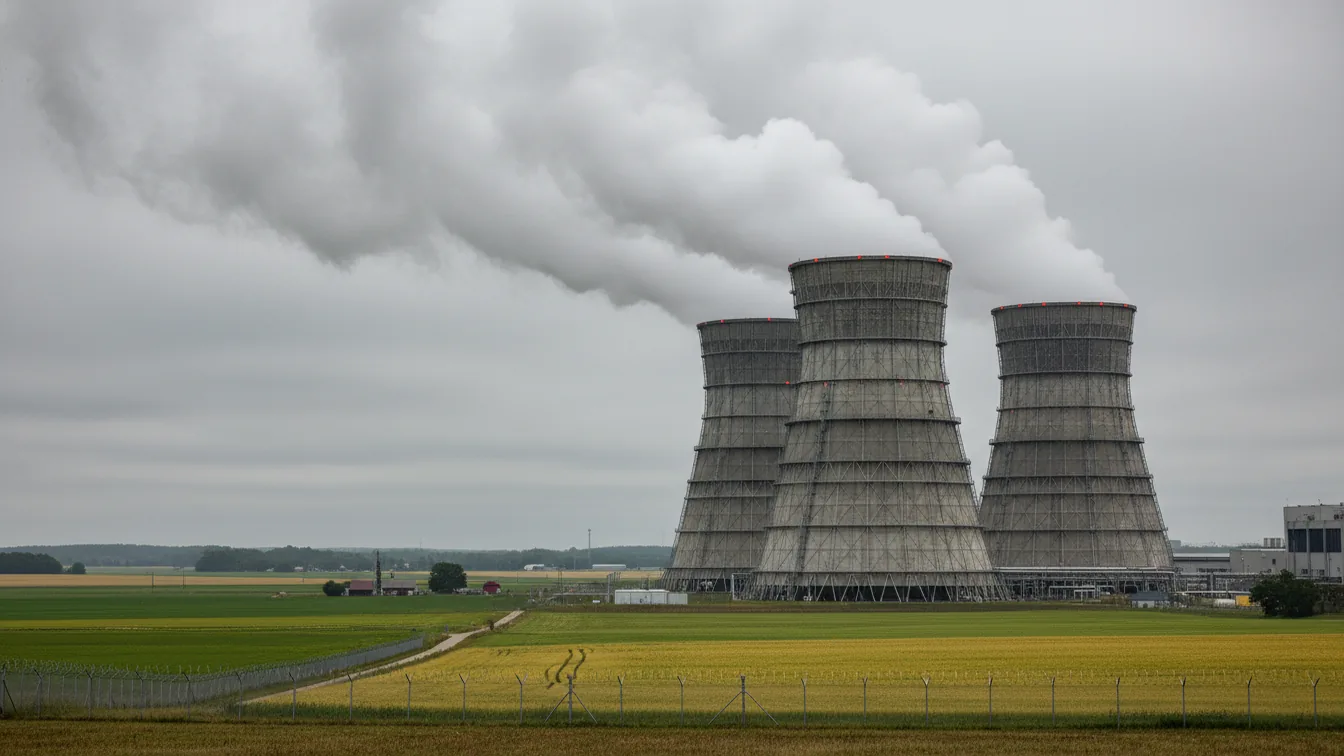
The Staggering Numbers
$650 billion. That's the amount four major tech companies were expected to spend in 2026 alone on new data centers. To put that figure into perspective, stack that amount in $100 bills and the pile would rise 710 kilometers. clearing the orbit of the International Space Station by over 300 kilometers. And the plan is to scale this number up to $9 trillion by 2030.
But here's the problem: nearly half of the data centers planned to open in the United States this year have already been delayed or cancelled outright.
According to a report by Bloomberg, around 140 data center projects were supposed to open in the US this year, representing roughly 12 gigawatts of computing power. enough energy to power 9 million homes. So far, only a third of them are actually being built. The rest sit entirely on paper: press releases and announcements with nothing to show for them.
A separate report by the Financial Times found that even the data centers that are being built will likely face major delays. The companies involved may deny it, but satellite imagery tells a different story. Microsoft, for example, has not finished a single data center that broke ground since 2023. The Fairwater data centers were announced as fully complete. they're not even half done.
"It's one of the strangest things I've seen in history," says Tom Blakeway, host of the ColdFusion documentary channel.
The Economy's Hidden Dependency
The scale of spending has become so enormous that it has essentially distorted the US economy. Last year, an estimated 92% of US GDP growth came from data center spending. Remove AI infrastructure from the equation, and the rest of the economy grew by just 0.1%.
This helps explain why the stock market's relentless climb has felt so disconnected from everyday reality. The entire market has become a proxy bet on AI infrastructure.
The frenzy has reached absurd proportions. The shoe company Allbirds recently announced it was pivoting to focus on leasing AI data center equipment. It made no strategic sense whatsoever. but their stock rallied 580% as a result.
"Data centers are in vogue," Blakeway observes. "The pitch was simple: AI gets smarter the more computing power you give it. Computing power comes from data centers. So let's build data centers fast."
In the US alone, the number of AI data centers went from essentially zero a decade ago to somewhere between 4,000 and 5,400 today. The pace and scale of the buildout has been so violent that more money has been committed to data centers in six years than was given to the Marshall Plan to rebuild Europe after World War II, the Manhattan Project to build the atomic bomb, the entire Apollo program, and the cost of the International Space Station. combined. with $120 billion extra left over.
All of this spending for a business plan that isn't even solid yet.
The Human Cost: Communities Under Siege
Beyond the completion issues, there's a growing and deeply personal backlash. The general public increasingly hates data centers. and for good reason.
Noise pollution. Residents living near facilities in Virginia, Georgia, and Texas report a consistent low-frequency hum from cooling systems. noise that vibrates through walls and disrupts sleep. One resident in Manassas, Virginia, spent $200,000 on soundproofing and new windows and still can't escape the drone.
Air pollution. In Virginia, it's estimated that residents are already breathing in the exhaust gases of 10,000 diesel generators powering data center backup systems.
Water contamination and consumption. In Georgia, families started finding heavy sediment in their taps after data center construction began nearby. According to the UN, data centers will use as much water as 1.3 billion people by 2030. One proposed facility in Utah. a 40,000-acre AI data center. would have expelled the heat equivalent of 23 atomic bombs into the surrounding valley every day. The backlash was so intense the owner was forced to shrink it to half the size.
A researcher from North Carolina working on a data center documentary revealed that a single facility was permitted to use 2 million gallons of water per day. with chemical additives like PFAS ("forever chemicals") that can't be removed from the water at treatment plants.
Skyrocketing electricity bills. The Georgia Power Utilities Company raised rates six times between 2023 and 2025. a 24% jump. directly attributable to data center demand. During that period, residents' wages didn't come close to matching those increases. In Oregon, Pacific Power consumers saw a 50% increase in their bills since 2020.
"$814 for one month of electric. This is ridiculous," one resident said. "How do they expect people to be able to keep their lights on when the bill is half of my mortgage?"
Who's actually paying the price? Not the shareholders. Not the companies collecting tax breaks. It's ordinary people. homeowners, families, communities. those who happen to live a few hundred meters from one of these facilities. They never got much say in the matter.
The Broken Promises
States like Virginia, Texas, Georgia, and Arizona rolled out the red carpet for data center developers, lured by promises of thousands of jobs and a new digital industrial revolution. One analyst compared it to the railroad boom of the 19th century.
The reality has been very different.
The companies bringing in these facilities often receive property tax abatements for years, meaning local communities absorb the infrastructure costs without the tax revenue in return. One report found Oregon schools lost $275 million in potential tax income due to these abatements.
And those promised jobs? They rarely materialized at the scale suggested. Even the largest data centers typically employ fewer than 150 permanent workers. Construction jobs are real and well-paid, but they're temporary. and many are filled by people from outside the state.
One Meta data center in Louisiana. nearly 400 times the footprint of the first data center Meta built to support Facebook, on track to be one-fifth the size of Manhattan, consuming nearly the average power demand of London. will employ only 150 people. "All this for about the same amount of jobs as my local Walmart," Blakeway notes.
The Supply Chain Bottleneck
The first and most fundamental bottleneck is power. These data centers are extraordinarily power-hungry. A single large hyperscale facility can consume as much electricity as a city of 200,000 homes. The modern GPU racks running models like Claude, Gemini, ChatGPT, and Grok use significantly more power than the servers that came before them.
According to Sighteline Climate, around 25% of planned 2026 projects haven't even disclosed how they plan to power themselves.
All the main electrical components needed to run these facilities. transformers, switchgear, batteries. are in critically short supply, and the majority are imported from China. As Bloomberg puts it: "America's data center buildout hinges on Chinese imports." High-power transformer imports from China surged from fewer than 1,500 units in 2022 to over 8,000 units in 2025. But with geopolitical tensions and tariffs disrupting supply chains, that pipeline has become unreliable.
"If one piece of your supply chain is delayed, your whole project can't deliver," one analyst noted.
Even skilled labor is a critical issue. Meta can't hire fiber technicians fast enough, so they've started training them for free. These tech giants aren't just short on equipment. they're short on the people required to install it.
The Financing Time Bomb
The hyperscalers have used up all their own cash and are now borrowing money. They are effectively net debtors at a time when they're spending huge volumes on data centers without any guarantee of profits.
"There's a structural problem here," Blakeway explains. "These investments are being made on the assumption that AI demand will grow exponentially and indefinitely. The infrastructure spending is very real, but the returns are still speculative."
The financing situation has become uncomfortable and echoes previous cycles. Around $34 billion in data center bonds were issued recently, with 84% of them rated A. a very safe level, low enough risk for pension funds to buy. But there's something fishy: those A-rated bonds are paying 8%, 9%, or sometimes 12% interest. That's junk bond-level rates, implying enormous risk that credit ratings haven't acknowledged yet.
"Where have we seen this before?" Blakeway asks. "Hint: it rhymes with 2008 crisis." This time, though, the risk isn't sitting in banks. it's concentrated in private investors and groups.
The DRAM Crisis
The AI data center boom has thrown chip markets into complete chaos. AI data centers are absorbing an estimated 70% of all global DRAM production capacity in 2026, and consumers are paying the price. A standard 64GB DDR5 memory kit went from $190 to over $700 in just three months.
Sam Altman was a key driver of this crisis, having promised to purchase 40% of global DRAM output from two manufacturers simultaneously. apparently without either one knowing about the other. When Micron learned the commitment wasn't legally binding, its stock dropped 22% in a single day.
The Backlash Builds
All of this has led to a powerful and growing backlash. Data center cancellations due to local opposition quadrupled in 2025. According to Heatmap Pro, at least 25 projects were cancelled that year due to community backlash, up from just six in 2024. And that number is accelerating.
A recent Quinnipiac survey found 65% of Americans now oppose data centers being built in their communities. Maine became the first US state to pass a statewide ban on data center construction, prohibiting new builds until late 2027. Thirteen other states are now considering similar measures.
This has become a kitchen-table issue: rising electricity bills, water consumption, and a sense that decisions are being made behind closed doors without community input.
In one small town, residents voted to prevent an AI data center from being built. but construction went ahead anyway. The town was sued by the developer. A small township like Celina simply can't defend itself in a lawsuit.
Illinois approved a data center the size of 600 football fields that will consume more than half the electricity of the entire city of Chicago. Hundreds of community members came out to oppose it. The city approved it anyway.
"Remember, these are the same people that tell you to take shorter showers," Blakeway notes.
The backlash has become so significant that the FBI has classified anti-AI sentiment as an "emerging terrorist threat." US law enforcement warns that "the chaotic atmosphere that may result from emergent AI technology in the next five years may fuel large-scale protests that devolve into civil unrest and anti-tech violent extremist activity."
Despite this, people keep fighting back. "They cancelled it!" one community member celebrated. "We are going to be fighting against data centers everywhere in New Jersey."
It's Not Just America
The crisis is global. In Australia, a quarter of Sydney's drinking water will soon be needed to power 270 new AI data centers. Australia's data centers are projected to use more new electricity than all of the country's homes and EVs over the next 15 years, with the potential to drive up power prices nationwide.
"I'm in Western Sydney, and this is just one of the many data centers popping up around the area," Blakeway reports from Australia. "We call it 'the Mortar' because it's so imposing over the whole neighborhood. You can literally see it from every corner."
The Pullbacks Begin
Microsoft has quietly cancelled or deferred up to 2 gigawatts of planned data center capacity globally. Analysts at TD Cowan described the pullbacks as pointing to "data center oversupply relative to current demand forecasts."
The famous Oracle-OpenAI Stargate campus in Texas has reportedly quietly stalled its expansion amid ongoing supply and financial complications. They had to do it quietly. because the speculation of the dreaded "B-word" is just around the corner: bubble.
Project Matador: A Cautionary Tale
In June 2025, Fermi America. co-founded by former US Energy Secretary Rick Perry. announced Project Matador, later rebranded as the "President Donald J. Trump Advanced Energy and Intelligence Campus." It was a 17-gigawatt AI mega-project in the Texas Panhandle, one of the most ambitious data center proposals ever announced.
In less than a year, the CEO resigned. The CFO followed two days later. The company still had no confirmed anchor tenant. the client who would actually lease the data centers, a basic prerequisite for any data center business. Its market cap collapsed from nearly $20 billion to $3.4 billion.
The departing CEO admitted he "may have misunderstood where the supply chain is in ending infrastructure."
"If the sitting president of the United States can't get his named data center off the ground," Blakeway says, "it tells you something about the broader state of the industry."
Is the Bubble Popping?
"Kind of," Blakeway assesses. "Probably not in the dramatic 2008 stock collapse sense, but it's definitely a strong reality check."
The AI buildout assumed infinite political tolerance, infinite grid capacity, infinite supply chains, and infinite community patience. None of these assumptions held.
Several threats loom over the business model:
Open-source competition. "Who would pay $20 or $200 a month to get something that's only 20% better than an open-source model that's free?" If free models are 80% as good, companies spending $1 trillion to train frontier models look ridiculous in comparison.
Compute constraints. If compute capacity keeps getting constrained. through cancellations, community bans, or supply chain issues. the companies that depend on it, like OpenAI and Anthropic, face a very real growth ceiling that has nothing to do with the quality of their models. There's even speculation that when a new model releases and performs well, it gets throttled down after a few months to save on compute costs.
The profitability question. The industry has absorbed over $1 trillion in the last three years. "But when you say, 'Hey, is it making any money?' They go, 'Oh, no. Oh, we couldn't possibly. We don't do that yet.' Uber burned about $32 billion. which is less than half of what Anthropic has raised in the last six months."
What Comes Next?
Despite the crisis, the story isn't simply "data centers bad." There are emerging alternatives and sustainable approaches worth watching.
Underwater data centers. China has deployed container-like capsules on the ocean floor, using naturally cold seawater as a passive cooling system. One operator reports that 99% of the electricity goes directly to computing, compared to roughly 50% in traditional air-cooled facilities.
Local AI models. Instead of relying on billion-dollar data centers, smaller models that run locally on your device are becoming more common. If they're 80% as good, most users will be satisfied for everyday tasks. Apple's unified memory architecture is a leading example of the hardware enabling this shift. In three years, when most laptops can run decent models, demand for centralized infrastructure could drop significantly.
Commoditization. Even Larry Ellison has hinted that all mainstream LLMs may eventually become commodities. When every model is trained on the same publicly available data, differentiation becomes difficult, and the economic case for massive infrastructure spending weakens.
Community engagement. "Community engagement and transparency need to become foundational," Blakeway argues. "It can't be an afterthought. The backlash happening right now, at its core, is a failure of trust."
The Bottom Line
"We've always needed data centers," Blakeway concludes. "Before AI, they were quietly running everything from our bank accounts to our streaming services. The truth is, they're not going away, and they probably shouldn't be."
"But the question isn't whether we should build them at all. It's how. And it's also a question of whether the amount being built is really worth the payoff."
"If we're raising electricity prices for hardworking communities so someone on X can generate a meme by typing a few words, while other people fill the internet with slob. call me crazy, but that doesn't sound like a great trade-off to me."
The $650 billion question isn't whether AI will transform the world. It's whether the infrastructure being built to support it is being constructed on a foundation of sound economics, sustainable energy, and community trust. or on hype, tax breaks, and borrowed money.
Right now, the evidence suggests it's the latter. And the bill is coming due.
This article is based on the ColdFusion documentary "Why Building AI Data Centres Isn't Working Anymore" (664K views). ColdFusion is an award-winning documentary channel covering technology, economics, and the systems that shape our world.