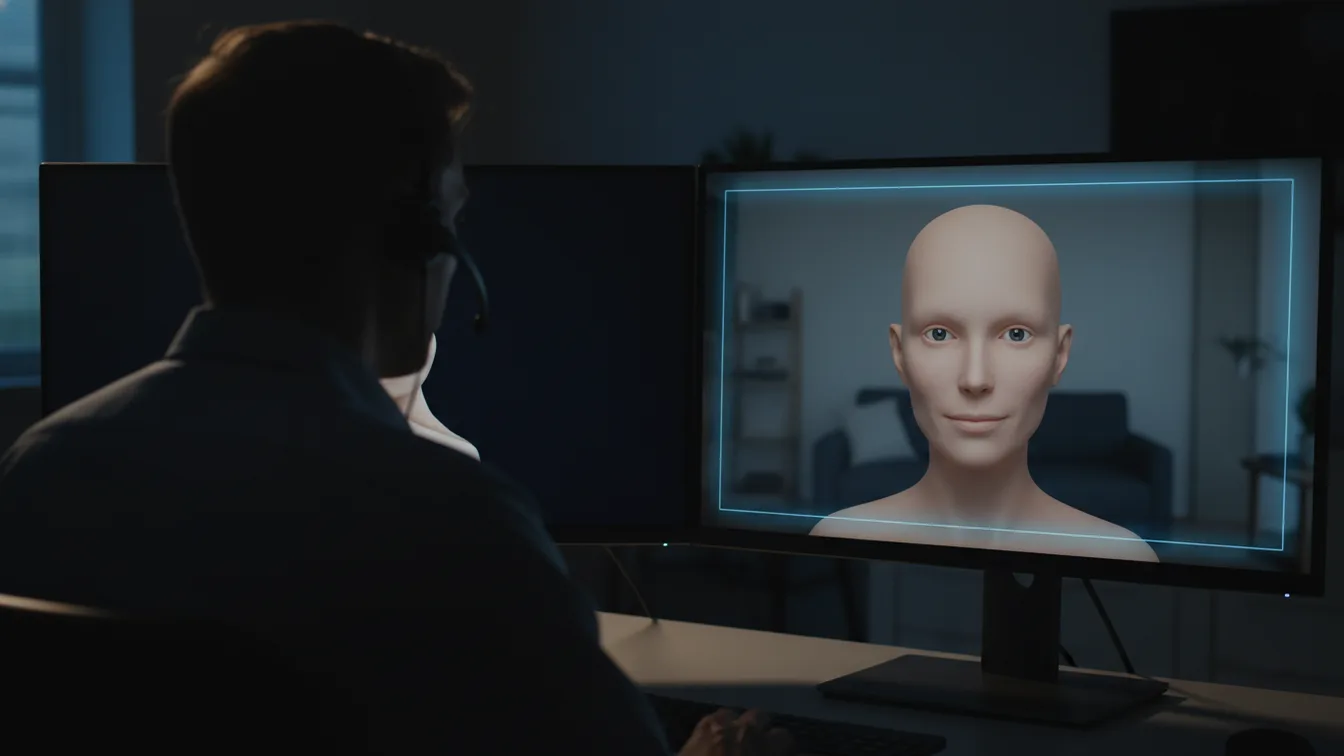
The candidate with the looping head
A recruiter was five minutes into a video interview for an AI engineering role when she noticed something wrong. The candidate's head was moving in a repetitive pattern. Not quite natural. Almost like a loop.
She kept going. Maybe it was camera lag.
Then the candidate started talking. For two minutes straight, no pause, no breath, no filler word. Perfectly fluent, textbook delivery. She asked the most basic question she could think of: "What is AI?"
She got back a scripted response. She asked again. Identical response. Word for word. Third time: still identical. Then the call dropped.
The recruiter posted about it to r/recruiting. "Turns out," she wrote, "I had just spent 40 minutes talking to an AI agent. HR later told me the real candidate had joined briefly at the start to introduce themselves, and then somehow, the bot took over. It even looked almost identical to the person's LinkedIn photo."
The post hit 15,000 upvotes. The comment at the top, with 1,155 points, observed: "Well, doesn't that go as a portfolio project for AI engineer?"
Even the post might be AI
The second-highest comment, at 595 points, said: "This is literally written by AI." It pointed to the recruiter's comment history, which the commenter claimed was full of AI product advertisements.
This is the part that matters. Not whether the interview story is true. The phenomenon it describes is documented across dozens of verified reports. What matters is that we are now in a moment where the post warning us about AI infiltration may itself be AI-generated content deployed to drive traffic. The recursion is dizzying and it is not accidental. Someone, or something, recognized that the most viral content in AI circles is content about AI doing something alarming.
The interview story is a useful anchor regardless. The tells the recruiter described (looping animation, verbatim repeated answers, no physiological signs of a thinking human) are real signatures that real AI impersonation systems produce. Microsoft, LinkedIn, and cybersecurity firms have all published guidance on detecting deepfake video in interviews. The pattern is documented. The scale is not.
What the other side is doing
While candidates send AI agents to interviews, companies are sending AI agents to do the actual jobs.
A software engineer posted to r/cscareerquestions about watching his company's pilot AI tool take a Jira ticket, read through the codebase, write a SQL query, update backend code, create a pull request with a well-written description, and push it for review. All in a few minutes. A senior engineer reviewed the PR and said it was solid. "They would have done it the same way."
"Watching it do my job in my codebase made everything feel real in a way headlines never could," the engineer wrote. "It was a ticket I would have knocked out before lunch."
His post hit 4,700 upvotes. The question he asked at the end, "What are you doing to adapt?" received hundreds of answers, most of which amounted to: not much yet, but watching carefully.
The company that required it
Around the same time, a developer posted to r/webdev about being rejected from a job after his final-round interview with the CEO. The rejection email contained one line that stuck:
"Thank you for your time. We've decided to move forward with someone who prioritizes AI-first workflows to maximize productivity and shape the future of tech."
His offense: telling the CEO that he uses AI as "smarter autocomplete, not a crutch." He had argued that LLM-generated code tends toward overengineering and security gaps, that you can't vibe your way to production.
The company disagreed. Not about whether his concerns were technically valid. About whether having those concerns was the right attitude.
The post got 4,600 upvotes. The comments split roughly in half: half thought the company was a red flag, half thought the candidate had read the room wrong.
The arms race
What these four stories describe together is a negotiation happening without any of the parties sitting at the same table.
On one side: companies that use AI to screen hundreds of resumes before a human sees them. That use AI to generate job listings optimized for keyword matching. That have deployed AI agents to handle work that surviving employees used to do, and are now requiring those employees to also use AI to stay employed.
On the other side: candidates who use AI to write resumes tailored to those automated screens. Who use AI to prep for interviews. Who, at the outer edge, send AI avatars to attend the interviews themselves.
Between them: a system originally designed to match human skills with human needs, now running almost entirely on inference rather than information.
The Turing test was proposed in 1950 as a way to determine whether a machine could imitate a human convincingly enough to fool an observer in a text conversation. Alan Turing's point was not that passing the test would prove intelligence. His point was that it would reveal something about how we decide what counts.
The job interview has always been a version of that test. Can this person perform, under observation, in a way that makes the observer believe they will perform when not observed? The question was always partly about demonstration and partly about trust.
What is new is that both sides are now performing for each other using the same tools. The interview is a Turing test in both directions. The candidate is asking: is this company worth working for, or has it replaced its thinking with automated optimization? The company is asking: is this person worth hiring, or have they replaced their thinking with automated optimization?
Neither question has a clean answer right now.
The tell that matters
The recruiter said the thing that gave the AI away was the looping. Natural human movement has micro-variations. A head nodding in thought does not repeat the same arc twice in a row. An AI model generating video frames from a static LinkedIn photo does.
That specific tell will be fixed. The next generation of deepfake candidates will have better motion models. The verbatim repeated answers will be replaced by paraphrased ones that still contain the same information. The breath sounds will be synthesized.
What will not be fixed, because it is not a bug, is the underlying asymmetry: the AI candidate optimizes for passing the interview, not for doing the job. Those are different targets. They have always been different targets. Human candidates game interviews too. But a human who games an interview and gets the job still has to show up every day and produce something. An AI candidate, if the deception goes undiscovered, places a human in a role the human may never have applied for.
The engineer watching AI take his Jira tickets is not facing the same problem as the recruiter who interviewed a bot. But they are experiencing the same shift: the employment relationship they understood is being renegotiated, in real time, by parties who did not consult them.
The job interview is now a Turing test. The question is who it is testing, and for whose benefit.
Sources
- r/recruiting: 5 minutes into the interview, I realised my candidate wasn't human — 15,342 upvotes
- r/cscareerquestions: I just watched an AI agent take a Jira ticket and push a PR — 4,737 upvotes
- r/webdev: Rejected for Not Using AI First — 4,618 upvotes