What Most "AI-Proof" Lists Get Wrong
Most articles about jobs AI cannot take are really articles about jobs AI has not taken yet. They list professions that require creativity, or empathy, or "human connection" , and they hope those things are enough.
They might be. But "hope" is not a career strategy.
There is a more rigorous question: what specifically makes a task resistant to AI automation, beyond "it seems hard"? The jobs on this list have a concrete answer.
The Actual Criteria
The jobs AI genuinely cannot do share a specific combination of properties:
Real-time judgment under genuine uncertainty. Not pattern-matching against historical data. Responding to situations that have never occurred in exactly that configuration before, with incomplete information, under time pressure.
Physical consequence if wrong. When an error means someone dies , not someone loses money or has a bad experience, but actually dies , the stakes change what "good enough" means. AI systems optimise for average performance. Average performance is catastrophic in these roles.
Dynamic environments that do not repeat. AI is extraordinarily good at stable environments with defined inputs. It struggles in environments where the rules change mid-task, where edge cases are common, and where no training set has captured the full range of what can happen.
Five Roles That Qualify
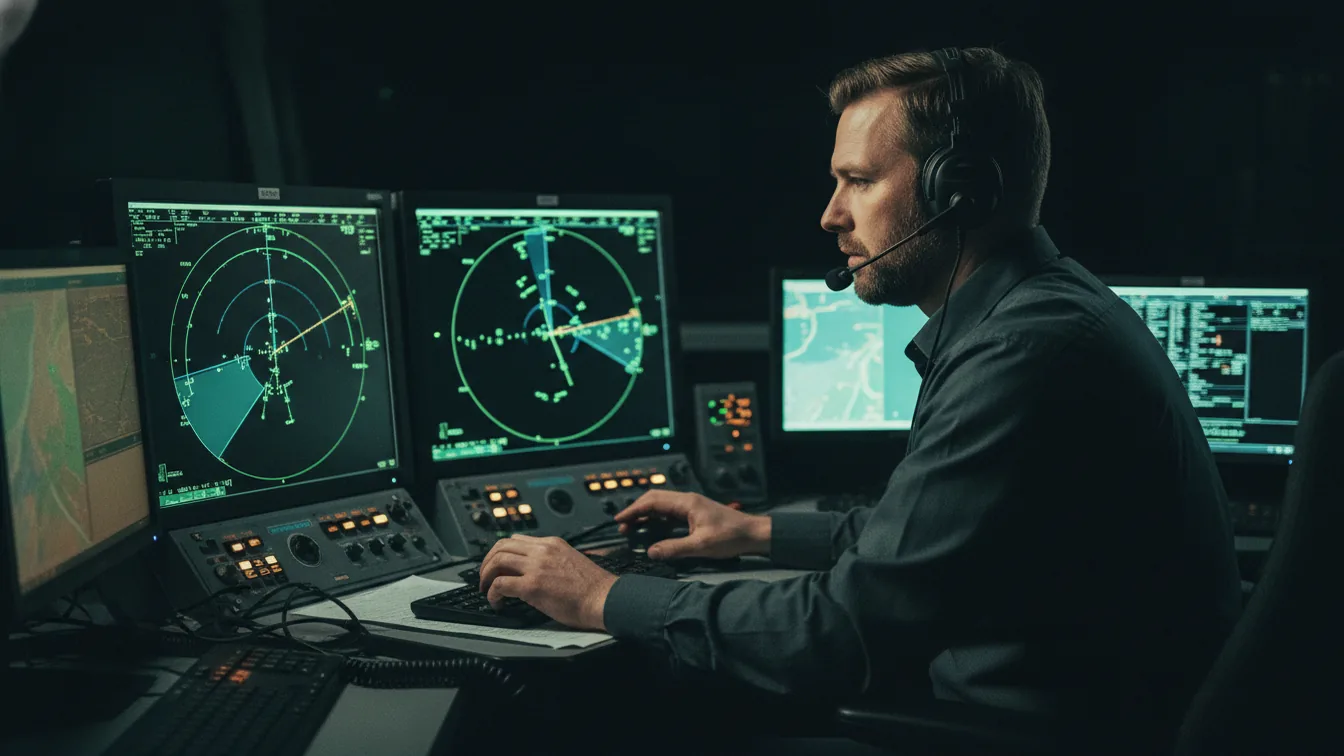
Air traffic controller. The signature example. Every second of a shift involves simultaneous awareness of dozens of aircraft in three-dimensional space, changing weather, equipment anomalies, and human communication in real time. The FAA has looked at AI augmentation for thirty years. Control still sits with humans. Median pay: $132,000. No degree required , FAA Academy training only.
Power grid operator. Someone has to manage the physical electricity infrastructure , transmission lines, substations, load balancing , when something unexpected happens at 2 AM. Grid failures cascade faster than AI can model them under novel fault conditions. Operators earn $80,000–$140,000 depending on region.
Surgical technologist. Not the surgeon. The person who hands the surgeon instruments, manages the sterile field, and anticipates what will be needed next based on real-time conditions inside a human body. The tactile and spatial judgment required is irreducibly physical. Median pay around $58,000 but rising steeply toward $80,000+ in specialist settings.
Firefighting aircraft coordinator. Aerial firefighting operations involve real-time coordination between aircraft, ground crews, and fire behavior prediction in environments that change by the minute. There is no such thing as a routine drop. Pay ranges from $70,000 to well over $100,000 for senior operations coordinators.
Nuclear plant control room operator. Regulated extensively, trained rigorously, paid accordingly , median compensation around $100,000. The work involves continuous monitoring of complex interdependent systems where the failure mode for a wrong decision is not recoverable.
The Checklist for Your Own Job
Three questions. Honest answers only.
- Does my role require judgment in situations that have genuinely never occurred before, under time pressure?
- If I am wrong, does something physical and irreversible happen?
- Does the environment I work in change in ways that make historical patterns unreliable?
Three yeses and you have structural protection. Two or fewer and you should be paying attention to what is coming for your industry.
The air traffic controller is not safe because the FAA likes humans. They are safe because the job, as it exists, cannot be done without the specific kind of judgment humans provide. That is a different kind of security , and it is the only kind worth building a career around.