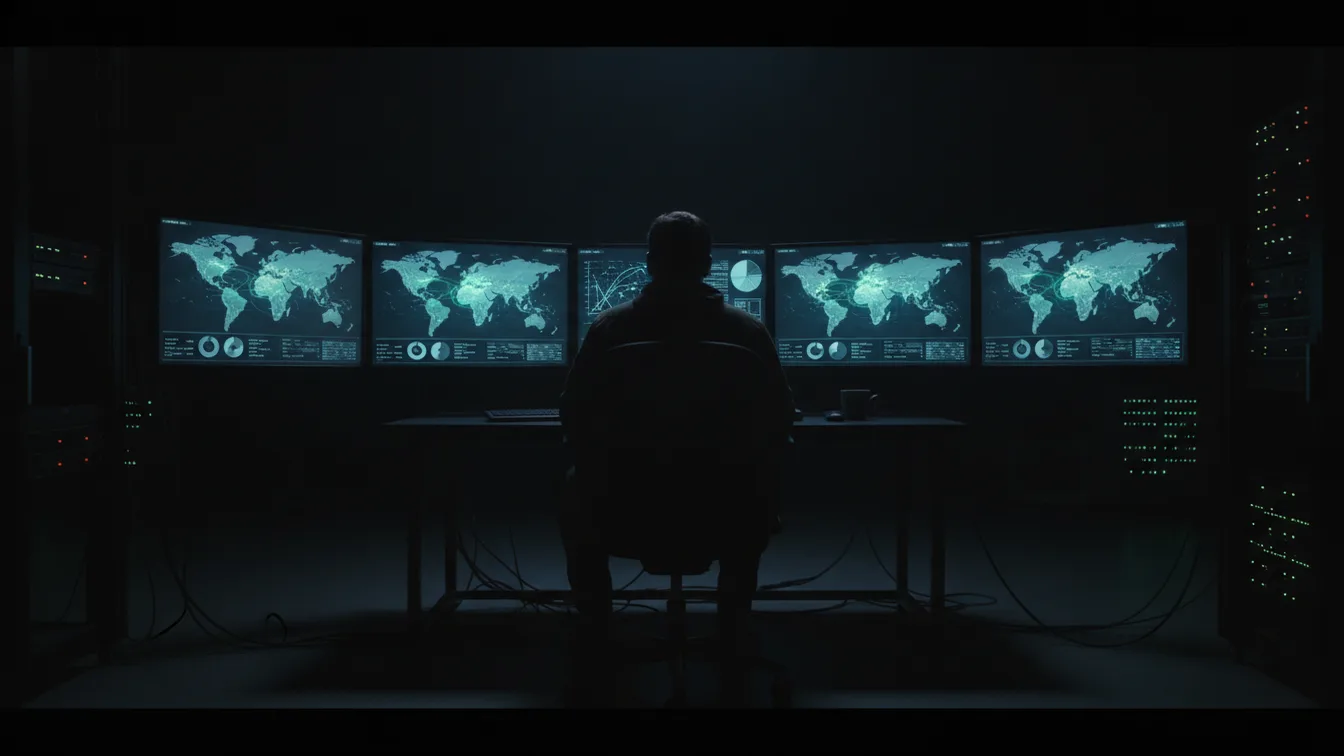
The Question Four Corners Actually Asked
Australia's flagship investigative programme did not ask whether artificial intelligence is good or bad. That framing, the documentary made clear, is a distraction. The real question is simpler and more uncomfortable: who decides?
The answer, as Four Corners laid it out over the course of its investigation, is a group of roughly six to eight companies, all American, none elected, and none subject to any international body with the authority to override their choices. Not governments. Not regulators. Founders, investors, and executives making calls that affect billions of people with no formal mechanism for accountability.
That is not a polemical reading of the documentary. It is the documentary's central finding.
The Concentration Problem, in Concrete Terms
The documentary walked through three specific decisions to make the abstract concrete.
First: Meta's decision to release its Llama model as open source. That decision was made unilaterally by Mark Zuckerberg. It may be irreversible. Once a frontier model is public, it cannot be un-released. No government was consulted. No international body weighed in. A single executive made a choice with potentially permanent global consequences.
Second: OpenAI's conversion from a safety-focused nonprofit into a for-profit commercial entity. The organisation was founded on the premise that AI development was too important to be driven by profit motive. The restructuring effectively abandoned that premise. The process involved minimal external oversight and faced no binding regulatory review anywhere in the world.
Third: Google's decision to deploy AI Overviews in its search product. This changed how billions of people receive information about the world. It was decided internally. It was rolled out to users who had no meaningful choice about whether to participate. When early errors surfaced, the company adjusted quietly. There was no public process, no impact assessment, no requirement to demonstrate safety before deployment at scale.
These are not hypothetical future risks. They are decisions that have already been made, by specific people, at specific companies, with specific effects on the rest of the world.
What This Means for Australia Specifically
Australia has no domestic frontier AI capability. That is not a criticism; it is a fact about scale. Building and running the kind of models that matter requires capital and infrastructure concentrated in a handful of American companies.
The practical consequence: every Australian using AI is using a system built, hosted, and governed under US law. The terms of service are American. The moderation decisions are American. The capability limits, the access policies, the data handling practices, all of these are set in San Francisco and applied in Brisbane without any meaningful Australian government input.
A policy decision made at OpenAI's offices affects Australian users immediately. An Australian government decision about AI governance affects OpenAI not at all, unless the US government chooses to act.
Four Corners pressed Australian government representatives on this directly. The responses were careful. An expressed intent to be "innovation-friendly." A framework consultation underway. Safety concerns raised and noted. Nothing binding. No timeline for binding regulation. No articulated plan for what Australia would do if a major AI company made a decision that caused real harm to Australian users or institutions.
This is not a uniquely Australian predicament. Most countries, including large democracies in Europe and Asia, are in the same position: dependent on American AI infrastructure, subject to decisions made in American boardrooms, and without any effective mechanism to influence those decisions. The EU has moved further than most jurisdictions with binding AI regulation, but its rules primarily govern deployment and liability within Europe. They do not govern what models get built, how capable they become, or who has access to what.
The asymmetry is structural. The companies with the resources to build frontier AI happen to be concentrated in one country. That concentration is not going to resolve itself in the short term regardless of how good any other country's AI policy is.
The Governance Vacuum
There is no international AI treaty. There is no international regulatory body with enforcement authority over AI. There is no equivalent to the International Atomic Energy Agency, which at least provides a framework for inspections and accountability in nuclear technology.
The closest thing that exists is a set of voluntary safety commitments signed by the major labs at the AI Safety Summit in 2023. Those commitments are self-reported, self-defined, and carry no penalties for non-compliance. They are PR documents with aspirational language, not binding obligations.
The documentary noted that the labs themselves have pushed back on international governance frameworks, arguing that they would be slow, that they would be captured by governments with bad intentions, and that they would stifle the development of beneficial technology. These are not absurd arguments. But they conveniently lead to the same conclusion: the labs remain the primary decision-makers.
The alternative voices in the documentary, largely from the tech entrepreneurial community, argued that competition is the real check on power. If one company behaves badly, users will migrate to another. Markets will discipline irresponsible actors. Regulation, in this view, only entrenches the incumbents who can afford compliance costs.
The counter to that argument, which the documentary raised but did not fully resolve: the AI market is not currently competitive in the way this argument requires. The frontier is controlled by three or four players. The barriers to entry are extraordinary. And the harms from AI decisions, unlike the harms from a bad product, are often diffuse, delayed, and difficult to attribute to a specific actor.
The Accountability Gap
The documentary's sharpest observation was this: the people making the consequential decisions about AI face no meaningful legal consequences for getting them wrong.
This is not true of most industries that affect human welfare. A pharmaceutical executive whose company releases a dangerous drug faces regulatory sanction, civil liability, and in extreme cases criminal prosecution. A bank executive whose decisions contribute to a financial crisis faces at least the possibility of regulatory action. The frameworks are imperfect, but they exist.
For AI, they largely do not. If an AI system produces harmful outputs at scale, the company may face reputational damage and possibly civil suits. But there is no regulatory framework that defines what "harmful" means in advance, what the obligations of disclosure are, or what the penalties for non-compliance would be. The companies set their own standards and report their own compliance.
This matters because accountability structures shape behaviour. They are not just about punishing past failures. They are about creating incentives for caution in advance.
What the Documentary Left Open
Four Corners did not offer a solution. That is probably appropriate for a journalism programme. But the piece left several important questions without clear answers.
What would meaningful international AI governance actually look like? The IAEA analogy has limits. AI is not fissile material. You cannot put it in a box. Open-source models complicate any inspection regime. The technology diffuses rapidly and asymmetrically.
Would national regulation actually change anything? Australia passing binding AI laws would affect Australian companies. It would have limited direct effect on OpenAI, Google, or Meta, which are not incorporated here and whose services Australians would likely continue to use regardless.
And the competition argument is not entirely wrong. The market is more competitive now than it was two years ago. Chinese labs have narrowed the capability gap. Open-source models have improved substantially. Whether that competition is sufficient to discipline the major players on safety and governance is a separate question.
What Four Corners established clearly is the gap between the scale of the decisions being made and the accountability structures that currently exist to govern them.
The question of who controls AI's future has a current answer.
That answer is not a government, a treaty body, or a democratic process.
Whether that changes is a political question, and right now, it is not being treated as one.