The Recursive Part
Boris Cherny runs Claude Code. When asked about his own workflow, he said he does not write code.
He prompts Claude.
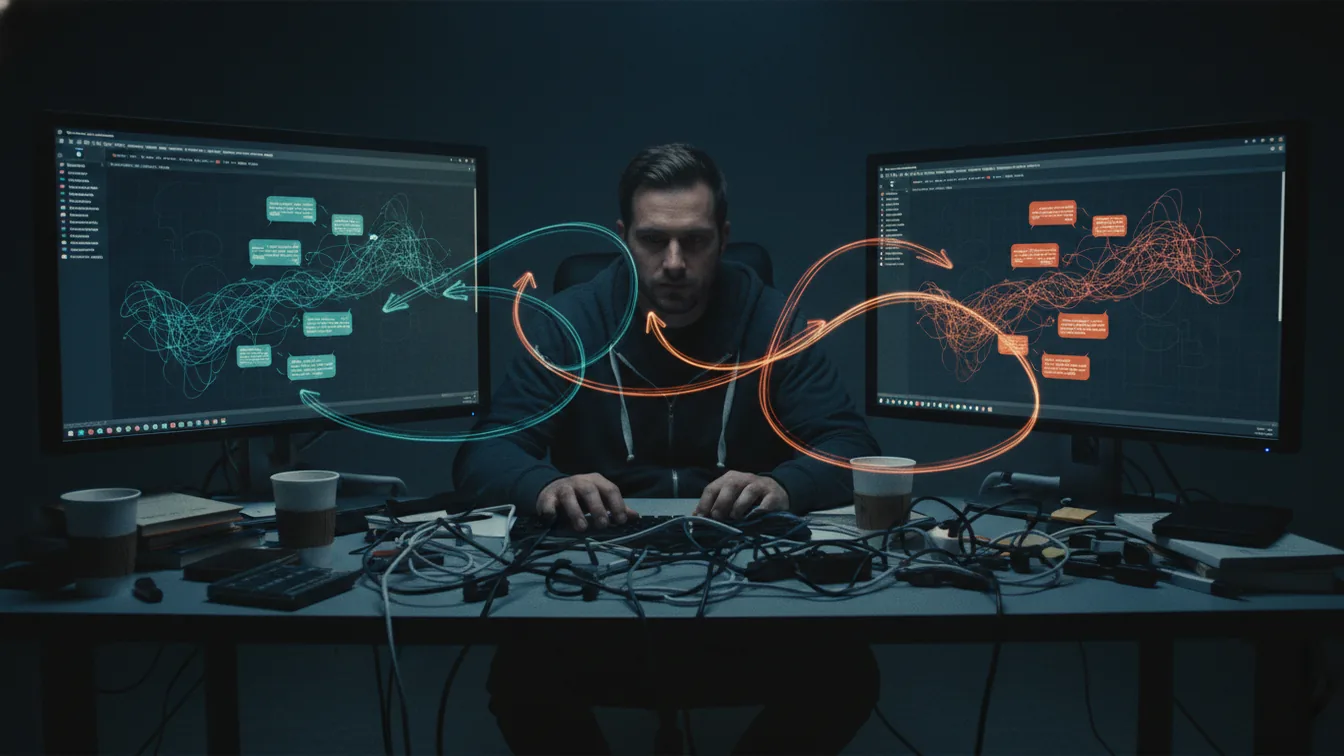
Then he said something that stops you mid-sentence: "Nowadays, mostly what I'm doing is I have a Claude that prompts other Claudes. So I don't even talk to Claude."
Claude Code is 100% written by Claude Code. Co-work is 100% written by Claude Code. An increasing number of Anthropic's features are fully written by Claude Code. The team building the tool is the tool's own primary user. The recursion is not a marketing line. It is the actual development process.
The Growth Number and What It Means
The growth Boris described as "just never seen this deep" , the kind that "kept going more and more exponential" , is not driven by one company tokenmaxxing. When asked whether large enterprise customers pushing extreme token volume account for most of the usage, the answer was clear: Claude Code has many, many customers. It is not like that.
The implication: the usage curve is organic and distributed. Individual developers, small teams, and companies across every industry are all driving demand simultaneously. That is a different shape of adoption than a few large customers inflating the metrics.
The Harvard Business Review Argument from 1990
Boris referenced a Harvard Business Review article from the 1990s. The title was something like: computers are here, why is no one seeing the productivity impact?
The question was serious at the time. Personal computers were becoming affordable. Mainframes were being replaced. And yet companies adopting computers were not seeing productivity gains. Why?
The answer from that article: companies were putting computers on the periphery of their existing processes. They still had paper filing cabinets. They still had desk drawers full of physical documents. The computer was somewhere in the corner. To get the benefit, you had to restructure the entire business process around the computer. Throw away the filing cabinets. Make the computer the center of how the work gets done.
The same thing is happening with AI right now.
Companies that are adopting Claude Code but structuring it around their existing workflows are not seeing the productivity gains. Companies that are restructuring their entire development process around AI , where the AI is at the center, not the periphery , are. Boris's description of his own work is the endpoint of that restructuring: he is not a developer who uses AI assistance. He is an orchestrator of AI systems that do the development.
What Tokenmaxxing Is and Why It Matters
Tokenmaxxing is the practice of throwing enormous amounts of compute at a problem , running the model many times, in parallel, on many variations of a task , to get better results than you would get from a single careful prompt.
Boris is aware of it as a trend. His observation: he does not know how many companies are doing this, but it is a real and growing pattern. The companies doing it are pursuing organizational change, not just technical experiments. They are trying to answer the question: how do you make an entire company benefit from AI? Not how do you make one developer more productive, but how do you restructure the business so that AI is doing work the company previously had to hire humans to do?
That question is harder than it sounds. Every company has a different culture, a different org structure, a different way of doing things. There is no single answer. But the companies making the most progress are the ones who have treated the question seriously, not as a side project.
The Direction of Travel
Claude Code writing itself. Features shipped without a developer typing a line. A team that functions as an orchestration layer rather than an implementation layer.
This is where it ends up. Not all at once, not for every company simultaneously. But the pattern Boris described at Anthropic today is what the rest of the industry will be doing in three to five years.
The people who understand that now , and who start restructuring their processes around AI rather than adding AI to the periphery of existing processes , will be the ones whose productivity gains actually show up in the numbers.