What Hermes Kanban Actually Is
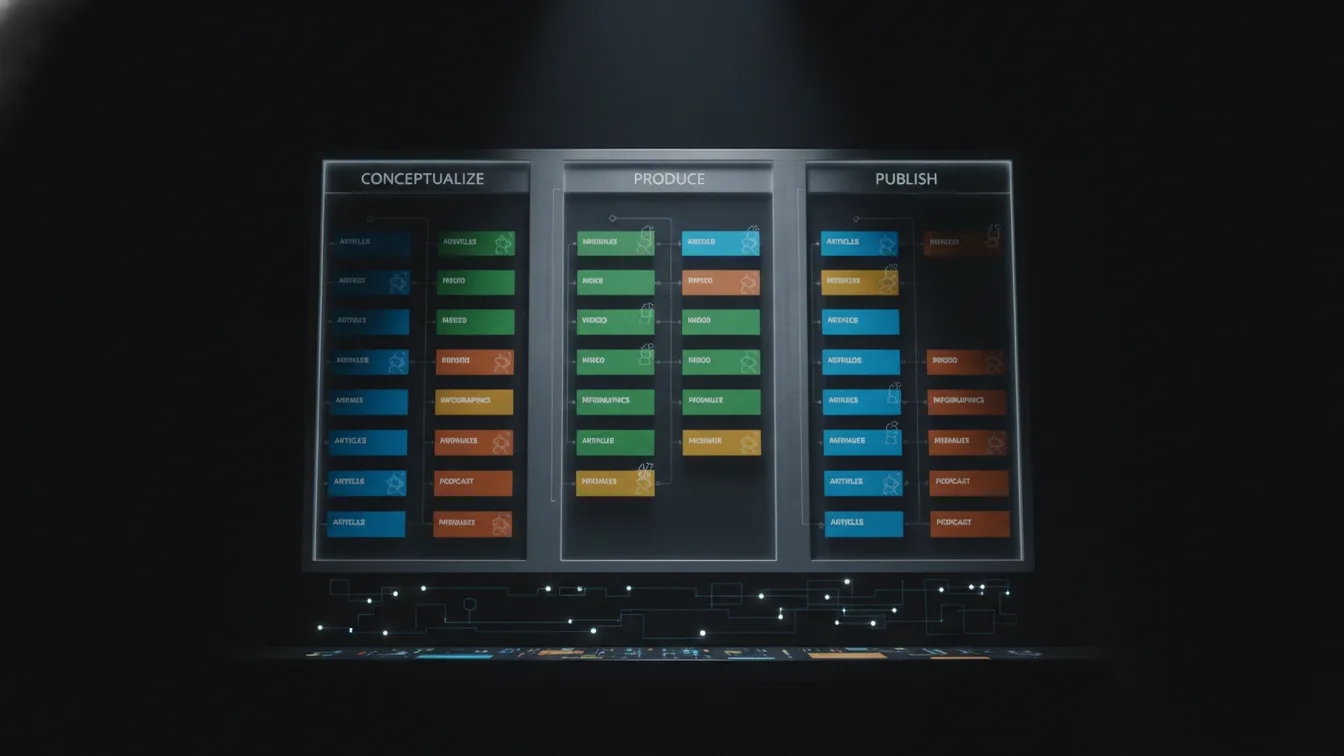
Most people hear "multi-agent" and picture something complicated. Hermes Kanban is not complicated. It is a task board where each column is a workflow stage and each card is a piece of work moving through that pipeline.
The insight is simple: different agents handle different stages. A research agent does not draft. A drafting agent does not edit. Each agent does one job, hands off the card, and the next agent picks it up. Responsibilities are separated by design.
That handoff mechanism is what turns a single agent running errands into a coordinated team with defined roles. The board makes the workflow visible. The agents make it run. And the combination produces something neither could achieve alone.
The Content Pipeline Use Case
The clearest demonstration of Hermes Kanban involves a creator running a blog, a newsletter, and a social media presence. Three channels, constant demand for fresh content, one human who can only write so fast.
The pipeline has four stages: Research, Drafting, Editing, and Human Review before publishing. Each stage is a column on the board. Each piece of potential content starts as a card in the leftmost column and moves right as agents complete their work on it.
The creator's job shifts from producing every word to reviewing the final output. That shift is the whole point. The pipeline handles production volume. The human handles the quality gate at the end and keeps editorial control without doing all the production work to get there.
Stage by Stage: How Each Agent Works
The Research agent monitors RSS feeds, Twitter/X, and newsletters continuously. When it finds something worth covering, it creates a card in the Research column with the source, key points, and a short note on why the topic is relevant to this creator's audience. The card moves to Drafting automatically.
The Draft agent picks up Research cards and writes a first draft. It does not write in generic prose. It writes in the creator's voice, defined in a CLAUDE.md skill file. Voice, tone, preferred structure, things to avoid , all of it lives in the skill. The agent reads the skill before it writes anything.
The Edit agent picks up Draft cards and applies the creator's editing criteria, also defined in a skill. It tightens sentences, checks structure, and flags any factual claims that need verification before the card moves to Editing. The creator sees a draft that already meets a defined standard, not raw output that still needs significant work.
Human Review is the final column. The creator reads, makes any adjustments they want, and hits publish. The agent does not publish autonomously. That decision belongs to the human, and keeping it there matters.
The Configuration That Makes It Work
A Kanban board without skills configuration is just a prettier to-do list. The agents need to know what to do, what standards to meet, and what format to produce. That definition lives in CLAUDE.md skill files attached to each agent instance.
Each agent has a different skill file. The Research skill defines what counts as relevant content for this audience , topics to cover, sources to trust, angles to avoid. The Draft skill defines voice, length, structure, and what the creator does not want in their writing. The Edit skill defines quality criteria and a checklist the agent works through before moving the card.
Without those files, each agent is generic. With them, each agent acts like a trained team member who already knows the style guide, the audience, and the standards expected of them. The board enforces the handoffs. The skills define the quality. Both are required.
What the Numbers Look Like
Before the pipeline, the creator produced two posts per week manually. That was the ceiling given the time required to research, draft, edit, and format each piece across three channels.
With the pipeline running in the background, the same creator now produces six to eight posts per week. The human time on content production dropped from roughly 80 percent of working hours to 20 percent. The agents handle the volume. The human handles the judgment at the stage that actually requires it.
That is not a marginal improvement. It is a structural change in what one person can sustain without burning out or hiring a full production team to keep the channels fed.
The Part That Surprises People
Most discussions of multi-agent systems focus on capability , what more can the agents do? The more interesting question is what the human no longer has to do. The capability ceiling goes up, but the human's working day looks essentially different too.
The creator in this pipeline used to spend the majority of their work week on production tasks: finding stories, writing drafts, editing for consistency, reformatting for each channel. These all feel like creative work. Most of them are not. They are execution tasks dressed up as creative ones , work that follows rules the creator could write down if they had to.
The agents took the execution. The creative judgment stayed with the human. The result is not that the creator produces more content by working harder. The result is that they produce more content by working on the parts that actually require their specific perspective , strategy, voice development, audience engagement, the final calls that only they can make.
That distinction , between execution work and judgment work , is what Hermes Kanban makes legible. Before the pipeline, both types of work came from the same person in the same workday, so the difference was invisible. The pipeline forces you to separate them, and once you have separated them, you realize how much of the total volume was execution all along.
Building the Skills Files: The Real Work
The skills files are where the actual intellectual work happens. Writing a good CLAUDE.md for the Research agent requires thinking carefully about what content is worth covering for a specific audience , not in the abstract, but in enough detail that an agent can make the call without asking. That means documenting topic areas, preferred source types, angles that resonate with the audience, and examples of content that performed well and why.
Writing a good Draft skill requires documenting voice in terms that an agent can act on. Not "write conversationally" , that means nothing. Specific patterns: sentence length preferences, how the writer opens a piece, what kinds of analogies they use, words and phrases they avoid, how they structure an argument. The more specific the skill, the more consistent the drafts.
Most creators have never had to document their own voice this precisely. The process of writing the skills files is itself valuable, separate from whether Hermes ever runs a single task. You come out of it with a clearer picture of what you actually do and why.
Why This Matters Beyond Content
The content pipeline is a clear example because content has obvious stages. But the same pattern applies to any workflow with distinct steps requiring different expertise: legal document review, customer support escalation, software QA, investor research synthesis, grant writing, or compliance checking.
What Hermes Kanban makes possible is the explicit design of multi-step workflows where each stage has defined criteria, defined output formats, and a defined handoff condition. You are not asking one agent to do everything and hoping it figures out the transitions on its own. You are building a system where each agent does one job well, the board manages the handoffs, and the human steps in at exactly the stages that genuinely require a human.
The content creator who adopted this workflow did not get more hours in the day.
They got a team that works while they sleep.
And the team's quality is determined entirely by how well the skills files are written.