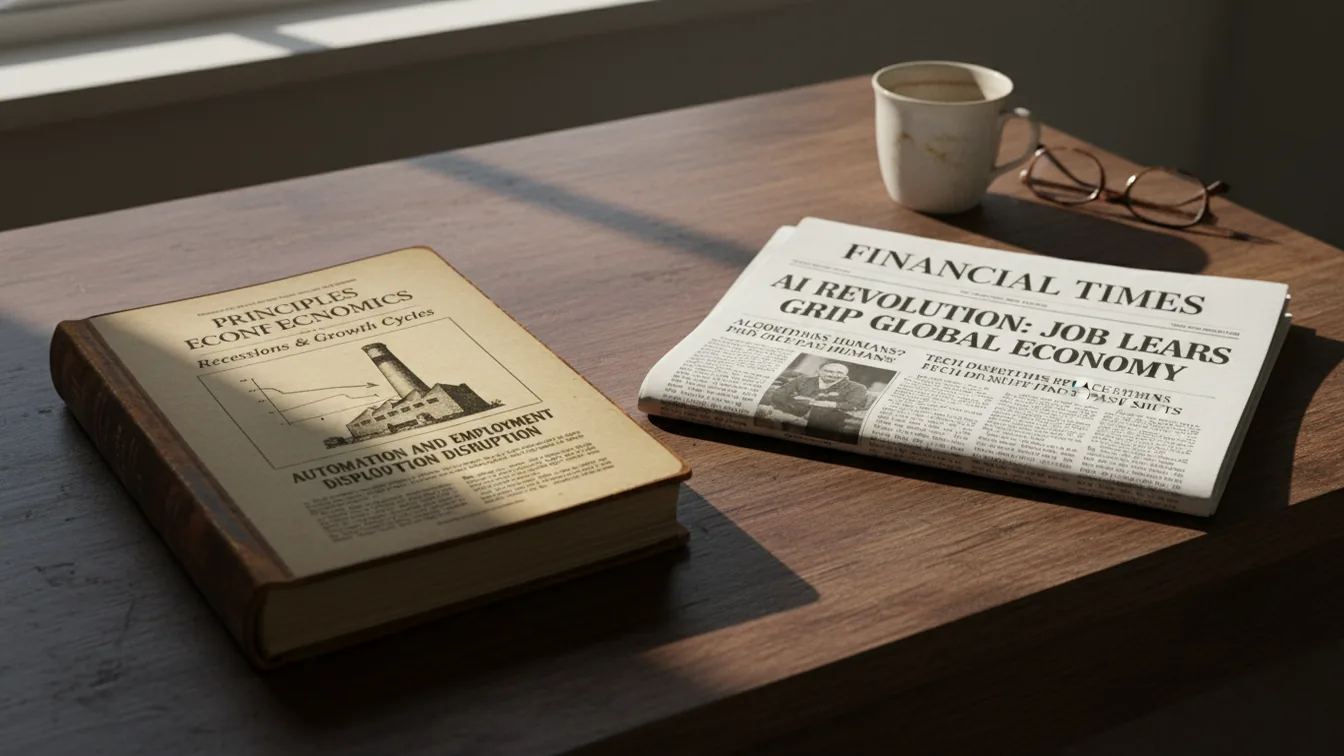
A 1962 Book About Factory Automation
Gunnar Myrdal was a Swedish economist writing in 1962 about what was happening to factory workers in the postwar boom. His subject was a class of people being displaced by automation , not temporarily, but structurally. He called it the permanent underclass.
The word "permanent" was doing specific work. Previous labor disruptions had created underclasses that cycled in and out , you lost one job, the economy eventually produced another. Myrdal's insight was that some displacement events were different. Workers who lost factory jobs in the 1960s did not just lose wages. They lost political representation, social standing, and access to the institutions that would have helped them transition. The underclass became self-reinforcing.
This thread is now appearing as a TikTok and X meme about AI. The lineage traces back to Myrdal. The fear is identical.
The Upgrade That Makes AI Different
Previous automation disruptions displaced workers from specific industries. The historical response , retraining, new industries, economic absorption , assumed there was always a next thing. Displaced factory workers eventually became office workers. Displaced office workers became knowledge workers.
The Myrdal framing applied to AI: if AI can do all human labor , every job a person can do, AI can do too , there is no next thing. There is no industry to retrain into. The displacement is not from one sector to another. It is from human economic participation to economic irrelevance.
Up to 50 percent of entry-level white-collar work is estimated at risk in current projections. The most exposed: clerical administrators and recent graduates. These are exactly the populations who historically would have been the pipeline to higher-skilled work.
The Self-Reinforcing Loop
Workers are responding in two opposite ways. Some are resisting , the ban-AI politics, the slowdown campaigns, the legislative pressure. Some are accelerating , "use AI or be left behind," learn everything, stay ahead of the curve.
Both responses share an underlying anxiety: the sense that AI is happening to people, not with them.
"People don't feel AI is happening with them. They feel it is happening to them."
That perception gap matters for adoption, for trust, for policy, and for the electoral math that will determine what legislation gets passed in the next two years. Policy response in the US is still early-stage ideation. Campaign-grade AI labor platforms are likely to emerge by the 2028 cycles.
The internet was the same panic in 2000. Transformative tech always gets overhyped first, crashes, then stays. The jobs that were lost to the internet did not all come back. Some of them never came back. The people who lost them did not move on in the way economists predicted.
Myrdal was writing about 1960s factory automation. He was describing exactly this.