Most AI comparisons focus on response quality: which model writes better, codes better, reasons better. This comparison is different. Hermes Agent and ChatGPT are not competing on the same dimension. They're fundamentally different products serving different needs. Understanding that difference will save you from choosing the wrong tool for your situation.
The Core Difference: Memory
Start here because everything else flows from it.
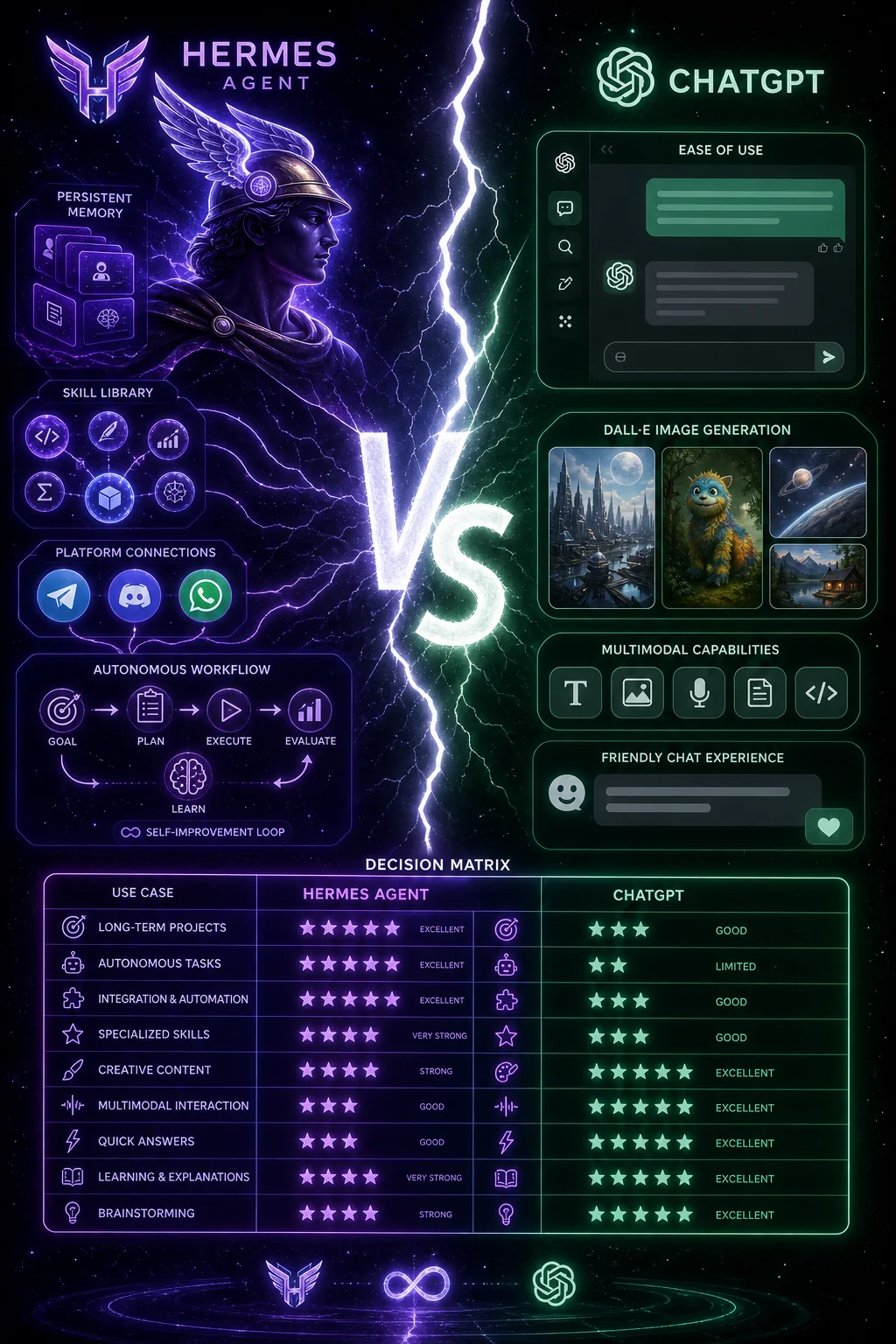
ChatGPT: Every conversation starts from zero. Open a new chat and ChatGPT knows nothing about you, not your name, not your projects, not your communication preferences, not what you discussed yesterday. You are, to ChatGPT, a stranger every single time.
Hermes Agent: Every conversation starts from context. Hermes reads your memory.md file before responding: a document that accumulates everything it has learned about you over months of use. It knows your name, your projects, your goals, your preferences, your current priorities, and the full history of your most important work together.
This is not a minor convenience difference. It's a fundamentally different user experience that compounds over time.
In month one, the difference is small. In month six, Hermes drafts emails that sound exactly like you, references your clients by name without prompting, anticipates follow-ups on projects it knows are in progress, and shortcuts tasks it has done for you dozens of times. ChatGPT in month six is identical to ChatGPT in month one.
What ChatGPT Does Better
Being honest about this matters. ChatGPT has real advantages:
Ease of Use
ChatGPT requires nothing. Go to chat.openai.com, type, get a response. No server, no setup, no configuration, no API keys. For occasional use or for people who just want answers quickly, ChatGPT's accessibility is a genuine advantage.
Hermes requires a VPS, SSH access, environment configuration, and about an hour of setup. That's not a criticism: it's a deliberate design for people who want a persistent agent rather than a conversational interface.
GPT-4o Multimodal Capabilities
ChatGPT Plus uses GPT-4o, which handles images, voice, and (for Plus users) web browsing natively. You can photograph a receipt and ask it to extract the data. You can have a voice conversation. You can ask it to browse the web and summarize what it finds.
Hermes's visual and voice capabilities depend on which plugins and skills you've configured. Out of the box, Hermes is more text-focused.
DALL-E Integration
ChatGPT Plus includes DALL-E 3 image generation natively. You can generate images directly in the conversation. Hermes requires setting up a separate image generation skill pointing to an image API.
No Maintenance
ChatGPT is a service, Anthropic handles uptime, updates, security. You pay $20/month and it works. Hermes runs on your VPS, which means you're responsible for maintenance, updates, and uptime. Not complex, but it's yours to manage.
Team Collaboration Features
ChatGPT Teams and Enterprise offer shared workspaces, admin controls, and organizational features. Hermes is primarily a single-user agent (though you can run multiple instances for different people).
What Hermes Does Better
Persistent Memory That Actually Works
Covered above, but worth emphasizing the practical impact:
After 3 months with Hermes:
- It addresses you by name without you typing it
- It knows your current projects without you explaining them
- It understands your writing style and produces drafts in your voice
- It remembers your preferred formats (bullet points vs. paragraphs, formal vs. casual)
- It knows your clients' names and contexts
- It follows up on projects it knows are in progress
This is not achievable with ChatGPT regardless of how much you pay.
The Skills System: Compounding Capability
ChatGPT processes each request from scratch. Every time you ask it to "analyze my CSV file," it reasons about how to do that from the beginning.
Hermes generates a Python skill the first time, saves it, and executes the pre-written code every subsequent time. By month three, you have a library of custom skills for your exact workflows. Tasks that required AI reasoning now execute instantly via stored code.
The compounding effect: Hermes gets faster and cheaper over time. ChatGPT's speed and cost are static.
Autonomous Operation
ChatGPT requires you to be present and active. You prompt, it responds. There's no version of ChatGPT that monitors your emails and proactively drafts responses, or runs a scheduled task at 7 AM without you asking.
Hermes runs continuously on your VPS. You can schedule tasks (morning briefings, daily research, weekly reports), set up automations that trigger on events (new email arrives, new lead submitted, scheduled time), and return to find completed work waiting for you. This is autonomous operation, not available in any ChatGPT tier.
Cost at Scale
ChatGPT Plus is $20/month for one user. ChatGPT Team is $25/user/month. For heavy automation work generating thousands of AI interactions per day, ChatGPT's token limits would require Enterprise pricing that scales to hundreds of dollars monthly.
Hermes at moderate usage: $40-100/month total, with the cost declining over time as the skill library handles more tasks without model calls. At high volume, Hermes with intelligent model routing is dramatically cheaper than equivalent ChatGPT usage.
16 Platform Integration
ChatGPT is available as a web interface, mobile app, and API. That's it (unless you build integrations yourself).
Hermes works natively across Telegram, Discord, Slack, WhatsApp, Twitter/X, Reddit, YouTube, GitHub, Notion, Obsidian, Google Docs, Gmail, Calendar, Linear, Jira, and direct API. Same persistent agent, same memory, available everywhere you work.
Self-Improvement
Hermes monitors its own skill execution, tracks success rates, and updates skills when it finds better approaches. It's not marketing language: the SQLite database logs every execution and the outcomes. Over time, Hermes's skill library improves through use.
ChatGPT doesn't improve based on your usage. The model is updated by OpenAI on their schedule, and your individual interaction history doesn't influence future behavior.
The Decision Matrix
Choose ChatGPT if:
- You want something that works immediately with zero setup
- Your use is occasional rather than daily
- You need DALL-E image generation built into your conversation
- You need multimodal (image, voice) capabilities out of the box
- You want to pay one flat fee without managing infrastructure
- You're using it for personal productivity without automation needs
Choose Hermes Agent if:
- You want an agent that knows and remembers you specifically
- You're running or planning automations that need to operate 24/7
- You want a single agent available across all your platforms
- You're doing content creation, research, or business operations at scale
- You want costs to decrease over time as the system learns your workflows
- You're willing to invest 1-2 hours in setup for substantial long-term gains
Use Both if:
- You want ChatGPT's instant interface for casual questions and multimodal tasks
- And Hermes for your serious automated workflows and persistent assistant needs
This is a common configuration: ChatGPT on your phone for quick questions, Hermes running on your VPS handling scheduled automations, content pipelines, and platform integrations.
The Philosophical Difference
At a deeper level, these tools reflect different philosophies about what AI should be.
ChatGPT is a service: powerful, accessible, frictionless, stateless. Every interaction is self-contained. It's designed for the maximum number of use cases with minimum setup.
Hermes is an agent: persistent, growing, improving, integrated into your specific life and work. It's designed for depth of relationship with a specific user over time.
Neither is wrong. They're different tools for different relationships with AI.
The shift from "AI as service" to "AI as agent" is the major transition in the field right now. Hermes is an early, practical implementation of what that future looks like: an AI that knows you, grows with you, works for you autonomously, and compounds in value the longer you use it.
ChatGPT will answer your questions well for years to come. Hermes, at its best, is something more: a capable colleague who never forgets anything and gets smarter about your specific needs every week.
That's the comparison worth making, not which one writes better, but which one you want to build a working relationship with.
Published on ai.quantummerlin.com, Your source for practical AI agent intelligence