If you've been looking for an AI agent that actually remembers who you are, learns from every interaction, and costs almost nothing to run, Hermes Agent from Nous Research is the answer. This guide covers everything: what it is, how to set it up, what it can do, and how real people are using it to generate income online.
What Is Hermes Agent?
Hermes Agent is an open-source, self-improving AI agent built by Nous Research. Unlike ChatGPT or Claude: which forget your conversation the moment you close the tab, Hermes maintains persistent memory across every session. It knows your name, your projects, your preferences, and your goals. Every time you use it, it gets smarter about you.
The core architecture is built around two memory systems:
- memory.md - a plain-text file where Hermes stores long-term facts about you and your projects
- SQLite database - structured storage for conversation history, skill metadata, and task logs
On top of that, Hermes generates and stores skills - reusable code snippets that it writes itself the first time you ask it to do something complex. The second time you ask, it pulls the skill from storage instead of re-generating it from scratch. This creates a compounding intelligence effect: the longer you use it, the faster and cheaper it gets.
Why Hermes Over Everything Else?
Cost: The 85% Savings Number Is Real
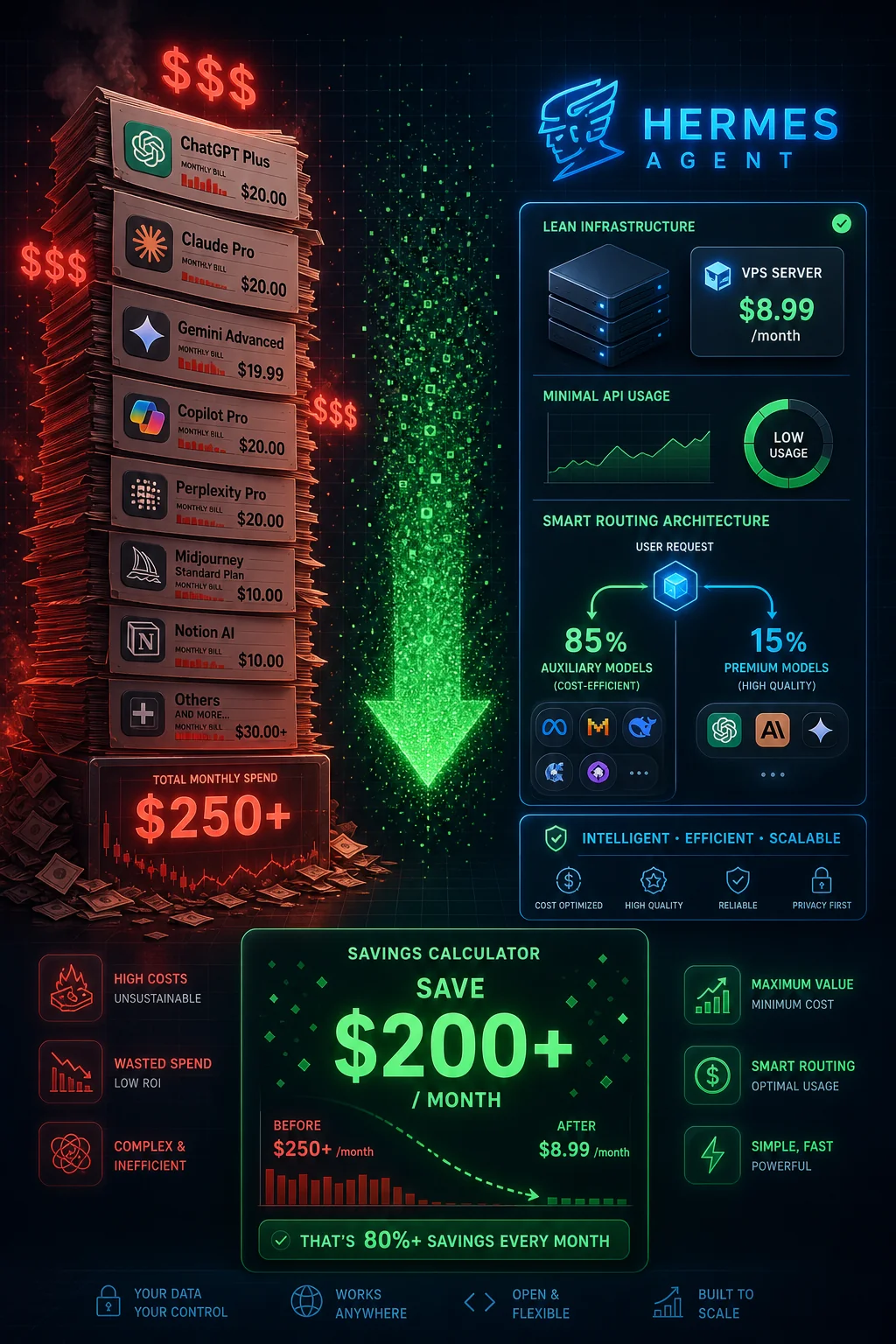
The most compelling reason most people switch to Hermes is cost. The auxiliary model routing system uses cheap, fast models (Nvidia Nemotron, RCAI Trinity, both free) to handle simple routing decisions, while reserving expensive frontier models (Claude, GPT-4o, Gemini) for complex reasoning tasks.
In practice, users report spending around $3/day at heavy usage, for an agent running continuously across multiple platforms. Running on a Hostinger KVM2 VPS at $8.99/month, the total monthly infrastructure cost is roughly $90-100. For what you get, that's extraordinary.
Memory That Actually Works
Every AI agent claims to have "memory." Most of them mean within-session context. Hermes memory is different:
- After each session, Hermes updates its memory.md with anything important you told it
- At the start of each new session, it reads memory.md and loads relevant context
- Over time, memory.md becomes a detailed profile of your preferences, projects, recurring tasks, and communication style
- The SQLite database logs every skill execution so Hermes can improve its own outputs
16 Platform Support
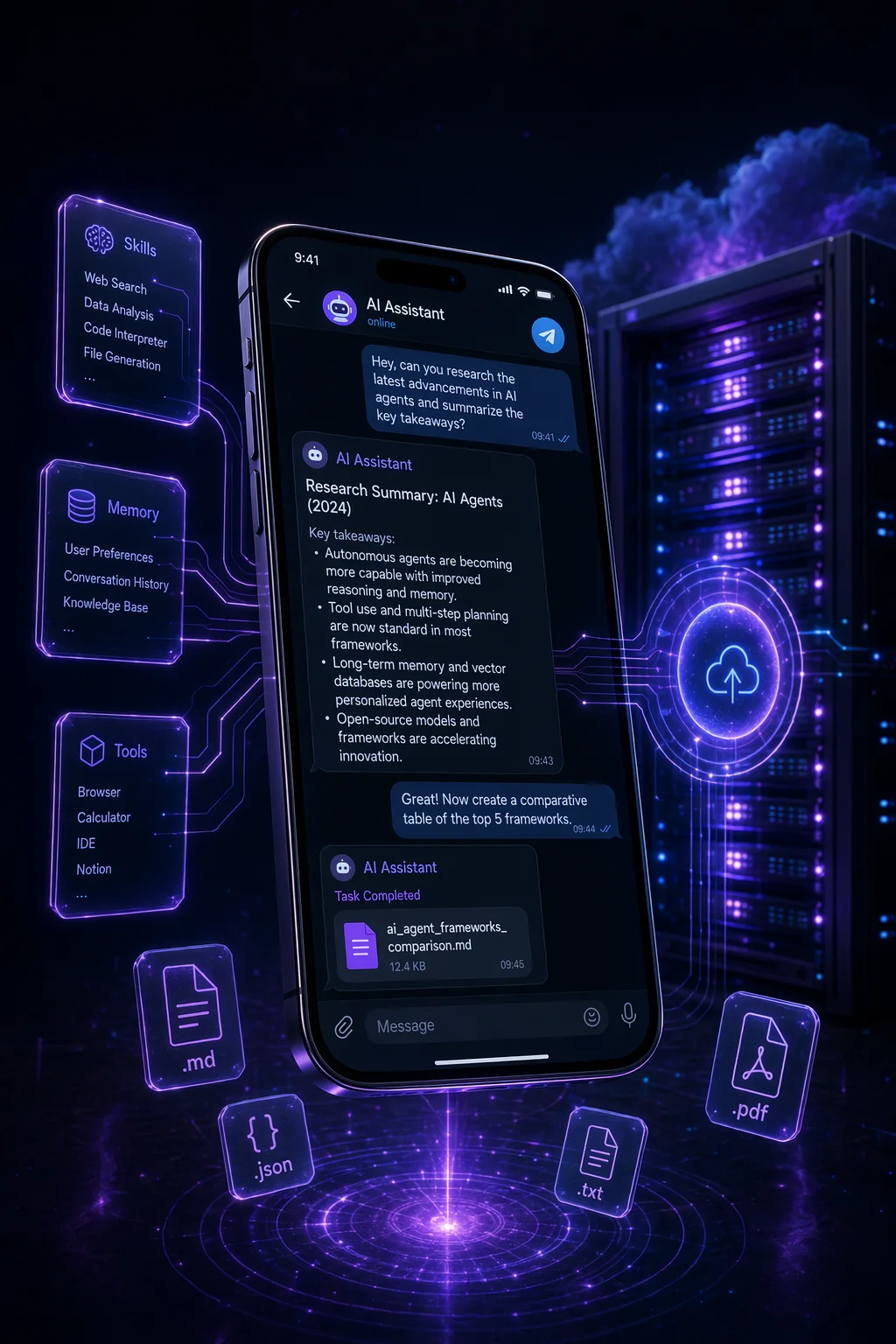
Hermes works across: Telegram, Discord, Slack, WhatsApp, Twitter/X, Reddit, YouTube, GitHub, Notion, Obsidian, Google Docs, Gmail, Calendar, Linear, Jira, and direct API. You can have the same persistent agent active on all platforms simultaneously.
74+ Built-In Skills
Out of the box, Hermes ships with over 74 skills including web search, file management, code execution, image generation, browser automation, email handling, calendar management, and data analysis. You can also write your own custom skills in Python.
Setting Up Hermes Agent: Step-by-Step
Prerequisites
Before you start, you'll need:
- A Linux VPS (Hostinger KVM2 at $8.99/month is the community standard)
- Python 3.10+
- An OpenRouter API key (free to create, pay-as-you-go)
- A Telegram account (recommended entry point)
Step 1: Get Your VPS
Sign up for Hostinger KVM2 or equivalent. Choose Ubuntu 22.04 LTS as your OS. SSH into your server:
ssh root@your-server-ipUpdate the system:
apt update && apt upgrade -y
        apt install python3 python3-pip git screen -y
Step 2: Clone and Install Hermes
git clone https://github.com/NousResearch/hermes-agent
        cd hermes-agent
        pip install -r requirements.txt
Step 3: Configure OpenRouter
Create your OpenRouter account at openrouter.ai. Add $20 in credits to start. Create a .env file in the hermes-agent directory:
OPENROUTER_API_KEY=your_key_here
        PRIMARY_MODEL=anthropic/claude-3.5-sonnet
        AUXILIARY_MODEL=nvidia/nemotron-4-340b-instruct:free
The auxiliary model handles simple decisions (routing, classification, formatting) for free. The primary model handles complex reasoning. This split is where the 85% cost savings comes from.
Step 4: Set Up Telegram Integration
Create a Telegram bot via BotFather:
- Message @BotFather on Telegram
- Send
/newbot - Choose a name and username
- Copy your bot token
Add to .env:
TELEGRAM_BOT_TOKEN=your_token_hereStep 5: Initialize Memory
Create your initial memory.md:
touch memory.mdAdd some seed context:
# About Me
        Name: [Your name]
        Projects: [Your current projects]
        Goals: [What you're building]
        Preferences: [Communication style, technical level]
Step 6: Launch
screen -S hermes
        python main.py
Detach with Ctrl+A, D. Your agent is now running 24/7.
The Skills System: Hermes's Secret Weapon
When you ask Hermes to do something it hasn't done before, say, "analyze my CSV file and create a chart": it:
- Breaks the task into steps
- Writes Python code to accomplish it
- Executes the code
- Saves the working code as a skill file (e.g.,
analyze_csv_chart.py) - Next time you ask for something similar, it loads the skill instead of regenerating
Over weeks of use, you accumulate hundreds of custom skills perfectly tuned to your workflow. Some users share their skill libraries publicly, so you can bootstrap a rich skill set immediately.
Most Useful Built-In Skills
Research & Information
- Web search with source aggregation
- YouTube transcript extraction
- Reddit thread analysis
- News monitoring with digest generation
Content Creation
- Blog post drafting from research notes
- Social media thread generation
- Email writing and sending
- Video script generation
Data & Analysis
- CSV/Excel analysis
- Web scraping
- Data visualization
- Market research compilation
Automation
- Scheduled task execution
- File organization
- API integrations
- Webhook handling
How People Are Making Money With Hermes Agent
Method 1: AI Automation Agency (AAA)
The highest-earning model. You set up Hermes instances for small businesses, automating their emails, social media, customer support responses, and data reporting. Typical pricing: $500-2,000/month per client. With 5 clients, that's $2,500-10,000/month in recurring revenue.
The pitch is simple: most small businesses spend 15-20 hours/week on repetitive communication and reporting tasks. Hermes handles that for them at a fraction of the cost of a human employee.
Method 2: Freelancing on Upwork/Fiverr
Use Hermes to deliver AI-powered services: content writing, research reports, data analysis, social media management. Hermes dramatically increases your output per hour. A researcher who used to deliver 3 reports/week can deliver 15 with Hermes handling data gathering and first drafts.
Rates typically run $50-150/hour for AI-augmented research and analysis on Upwork.
Method 3: Content Website + Adsense + Affiliates
Set Hermes to research trending topics in your niche daily, generate article drafts, and schedule them for your WordPress site. Traffic builds over 6-12 months. At 100k monthly pageviews, AdSense generates $200-500/month. Affiliate links to the tools Hermes uses (OpenRouter, Hostinger, ElevenLabs, n8n) can add another $500-2,000/month.
Method 4: YouTube Channel
Record yourself setting up and using Hermes features. These tutorials get consistent views because the software updates frequently and beginners always need help. Affiliate links in descriptions + AdSense + sponsorships = $1,000-5,000/month at modest scale (10k-50k subscribers).
Method 5: Digital Products
Create and sell Hermes skill packs, config templates, prompt libraries, and setup guides. Price range: $27-197. Sell on Gumroad or your own site. The audience for this is every other Hermes user: a growing market.
Affiliate Programs to Promote
If you build any content around Hermes, these are the affiliate programs that pay well and directly relate to the tools:
| Tool | Commission | Type |
|---|---|---|
| Hostinger | 60% | One-time |
| ElevenLabs | 22% | Recurring |
| HeyGen | 30% | Recurring |
| n8n | 20% | Recurring |
| Jasper | 30% | Recurring |
| Notion | 50% first year | Recurring |
| OpenRouter | varies | Per-usage |
Recurring commissions from ElevenLabs, HeyGen, and n8n are particularly powerful because one referral keeps paying you monthly indefinitely.
Common Questions
Q: Do I need to know how to code? Not really. The setup requires following terminal commands (all documented), but you don't need to write code. Hermes writes its own code when it needs to.
Q: How much does it actually cost per month? VPS: $8.99. API costs: ~$90 (at heavy usage, $3/day). Total: ~$100/month. Light usage is much less, maybe $20-30/month total.
Q: Is my data private? Your memory.md and skills live on your VPS. Your conversations go through OpenRouter to whichever AI model you're using. If privacy is critical, use a self-hosted model via Ollama instead of OpenRouter.
Q: What's the best model to use with Hermes? Claude 3.5 Sonnet for complex reasoning. Llama 3.1 70B for general tasks (cheaper). Nvidia Nemotron for auxiliary routing (free).
Q: Can Hermes run multiple bots simultaneously? Yes. You can run separate Hermes instances for different platforms or different client projects. Each instance has its own memory and skill set.
Getting Started Today
The fastest path to value:
- Sign up for Hostinger KVM2 ($8.99/month)
- Get an OpenRouter API key (free)
- Create a Telegram bot (free)
- Follow the setup steps above
- Give Hermes your first task: "Research [your niche] and write me a summary of the top 5 trends"
Within an hour, you'll have a running agent that remembers everything and keeps getting smarter. That's the Hermes promise, and based on the community's results, it delivers.
Published on ai.quantummerlin.com, Your source for practical AI agent intelligence